So you may be asking: what does a company delivering
mattresses on bicycles in New York City have to do with PeapodLife and
ecosystems? Quite a lot, as it turns out.
But let’s back up a moment.
When the online mattress startup Casper began selling their
mattresses for $500 US each, they decided on an innovative value proposition.
Using a two-ton compressor, the company stuffs their foam mattresses into a box
roughly 3 feet high (104 centimetres by 53 cm by 50 cm).
That means if you live in New York City, your mattress comes
delivered via bicycle; outside of NYC, regular delivery. Now, for anyone living
in a condominium, small apartment, and especially a walk-up or walk-down apartment,
dealing with a bar-sized fridge box can be much easier than with a queen-sized
mattress.
Suffice it to say, the concept caught on with millennials and
those not wanting to deal with the hassles of regular mattress delivery. Plus,
it makes for great ‘unboxing videos’ online:
“Our plan was to expand into Canada
in 2015, but we had an overwhelming amount of interest from Canadians asking if
we could ship it to them, so we’re starting [in 2014],” Casper co-founder and
chief executive Philip Krim said in an interview. (Financial
Post)
Now you might think buying a mattress before trying it is a
silly proposition. The company offers a 100-day in-home trial period. As for
price, at $650 CDN for a twin and $1000+ CND for a king, Casper’s products are roughly
a third less to half competitor’s mattresses made with comparable materials.
Innovation is the Key to Today and Tomorrow
If there’s a takeaway from this story it’s this: even
entrenched and stayed industries like mattresses (just think back to decades of
people buying their spring mattress at Sears) can be dragged kicking and
screaming into the 21st Century by disruptive technologies and
innovative new approaches.
PeapodLife’s mission is to disrupt the status quo of housing
and building, and bring innovation to an industry that is literally thousands of years old. And despite what
they’ll tell you, honestly very little has changed.
Innovative…But Sustainable?
Delivery via bicycle certainly smacks of environmental
consciousness. But there seems to be a lot of packaging that goes into one of
these super-compressed deliveries. When you think about it, if you buy a
regular mattress, that too comes wrapped in plastic; in fact, with the mattress
compressed, Casper may even use less packaging
than a regularly delivered mattress. But frankly, we just don’t know and haven’t
done the hands-on research to find out.
PeapodLife, on the other hand, begins from a foundation of
true sustainability—ecosystems. We can’t promise we’ll deliver your ecosystem
on a bicycle, nor will we promise an exciting unboxing video (at least, not yet);
but we will promise that once your high order rainforest ecosystem is installed
and filling your space with good vibes and the fresh, clean air of nature, you’ll
not only sleep better than you could have ever imagined, your waking hours will
be that much better, too.
In this part, the obvious allegory used is that of nature in relation to the broader environment that organizations are a part of. The example used is that of a “fish in water” or “a fish out of water.”
The film proceeds with a mind-numbing intellectual elaboration on this grossly reductive view of nature: that organisms have needs which they take from the environment. This is an anthropomorphized view of nature!
One cannot say “understanding natural systems is the way” and then anthropormize those systems, then say you are learning from nature!
Anyway, we are not going to make you watch all six parts of this series. Why? Because it’s an absolutely futile and useless waste of time; a mind-numbing intellectual exercise trying to solve a problem that was created by the very thinking that is being used to try and solve it.
Self-organization is not the antithesis of hierarchy. Hierarchies are everywhere in nature! Hierarchies self-organize all the time. Even in human group dynamics, hierarchies can form organically, whether or not the individuals involved are cognizant of these formations or not.
Intellectualization and defining this structure versus that structure is so limiting, so reductive, so unlike anything which happens in nature—and this series of films likes to use the word “reality” and “complexity” a lot—that it is not going to answer the questions being asked and the problems being raised by this series of films.
So what will?
For starters, how about comprehending what self-organization actually is, and how it works? No, not intellectually, not theoretically, but PRACTICALLY. How do you do that? By becoming a part of a self-organizing entity. Now, since we are grossly unconscious of the self-organizing phenomena occurring in our own bodies, our only other recourse is to become conscious of self-organizing phenomena around us.
Start with getting an ecosystem.
Whether you realize it or not, when you are in an ecosystem’s field of influence, you are actually part of that ecosystem. As it self-organizes, so you are being self-organized. As it seeks balance, so you are being balanced. As it assumes a posture of harmony and mutual symbiosis, so you are being harmonized and receiving the benefit of that symbiosis.
And how do you respond? As you imagine you might; unless you are cold-hearted, closed-minded, oblivious and uncaring, in which case no system of self-organization will connect consciously with you. An ecosystem will still try to “get through to you,” but even in nature, cancers and toxins exist. So, too, corrosive people and toxic attitudes can sabotage the best intentions of any effort at self-organization.
The point is, self-organization is intuitive. It is energetic, extra-sensory, and organic. Self-organization is not materialistic, and anything but intellectual! Trying to theorize your way through models of self-organization is like trying to understand infinite complexity. You can’t. No one can. The mind cannot grasp it. Nature doesn’t function that way. Nature senses, feels, intuits, and interprets flows of energy and influence. The physical reality we see is just the coarse veneer to what’s really going on.
If you really pay attention to group dynamics and human interactions, you will see that it’s very much the same for people. We can feel good vibes and bad vibes in the workplace; and individual dynamics functioning on a base level independent of perceived or established social structures can be explosive.
Attempting to self-organize without the presence of an ecosystem is a recipe for disaster because the natural tensions which arise in the self-organizing process are effected by the immediate environment. In most organizational environments, lots of harsh, negative energy is bombarding participants—from fluorescent lights to computer screens to toxic off-gassing from industrial building materials and carpeting to VOC’s, noise pollution, the list goes on and on.
An ecosystem provides the prerequisite for successful self-organization: harmony and mutual symbiosis; such that even self-organizing hierarchies, which in nature often require violent confrontation, are quickly calmed-down and dissipate once the selection process is complete. In the human context, disagreements and conflicts will arise. But an ecosystem is able to “take the edge off”.
Again, here we see how the best of intentions related to self-organization are hamstrung without the power of an ecosystem.
Ecosystems are not the only way nature self-organizes; but they are the most powerful expression of the underlying process of self-organization which we can interact with in an everyday sort of way. In other words, the earth is a self-organizing biosphere, but is far too vast for us to interact with as biological creatures in totality…we are mere specks compared to it. No, ecosystems are the natural, biological phenomena which we can best relate to and be a part of.
It is precisely the oneness we can experience with ecosystems which can inform our relationships, groups dynamics, organizational behaviour and evolving organizational structure; as we attune ourselves intuitively to our inner ecosystem, and thus expand our sensitivity from an organizational perspective to the outer ecosystems of community, economy, business environment, etc.
The Bottom Line
The intellect cannot, will not, and should not attempt to understand infinite complexity. It’s not its job. It was never designed for that task. The consciousness is another matter entirely. It can, should and with patience and discipline will comprehend the nature of infinite complexity. But only through direct experience, and only with little baby steps.
Self-organization is the product of countless billions of organisms playing out conscious interrelationships defined by harmony and symbiosis. Even if sacrifice and death appear on a regular basis, these too are a part of that self-organizing process of renewal, evolution and devolution.
Unfortunately the mind doesn’t like dealing with sacrifice, death, conflict and other “messy” aspects of self-organization. It wants everything to be sanitized and controlled…like a Swiss watch or an iPod. But watches and machines are designed. They do not; cannot self-organize.
To be comfortable in your own skin, to be comfortable in an ecosystem, to be one with the “messiness” of self-organization and evolution, going with the flow of events and not trying to control the process all the time…these are the keys to organic growth and evolving a self-organizing entity of harmony and mutual symbiosis. Having an ecosystem on site can make all the difference.
Gosh we dislike the term infographic. We much prefer SEE VISUAL AID (Strategize, Engage, Execute with Virtual Interactive Simulation, Universal Adaptive Language & Actionable Intelligence Discourse). Here’s a VISUAL AID that sums it up…
In it, the author does a good job of differentiating between information and insight, offering the following definition of insights in the context of customer acquisition:
Zambito goes onto explain some of the pitfalls of predetermination, that is, deciding ahead of time what insight you’re looking for and thus falling into the trap of accumulating information and not the seeds for authentic insight—which often arises from the unseen, unheard, unspoken needs of customers.
The implication is, of course, that what a CEO (or CMO) needs is not information, but insight, which we would describe loosely as follows:
Intuition, inspiration, imagination and integration of information which results in actionable intelligence; in a word, revelation.
Revelations lead to Revolutions
It follows that revelations are what lead to revolutions. Before any leader can revolutionize how their company operates, that revolution must first reveal itself to them. Likewise, before a company can revolutionize an industry, the object of the revolution (say, the iPad), must “come to them” (Steve Jobs).
So now we’re getting somewhere. There have been countless book and articles written about the creative process, but the fact of the matter is the mind cannot understand the mechanics of insight, mostly because there are no mechanics to understand. It is possible to comprehend insight in a deep metaphysical way (through meditation, for example), but how does this help the busy CEO dealing with the practical realities of their busy work life? So the question remains...
How can CEO's Grab Hold of More / Deeper Insights?
Let’s return to the question of information; and let’s say that the plants in your office (or that so-called ‘living wall’ consisting of plants stuck into a vertical framework of some kind) represent information.
There they are: individual plants arranged in a space. No connection to each other. No ability to collaborate. No chance of symbiosis. They may as well be prisoners in their cells.
But what if those plants were arranged a different way? What if instead of being treated as isolated individual plants, they were treated as a part of something much greater than themselves? What if they were part of an ecosystem?
Now those plants would be able to develop mutually advantageous relationships with each other, along with the animals in the ecosystem. Individual isolationism gives way to interconnectedness, harmony and mutual symbiosis—a kind of integration which relies on an infinite matrix of interrelationships.
The result is a super organism. An ecosystem is orders of magnitude more powerful and influential in an office space than individual office plants—a super organism reflecting nature in its highest expression, and able to directly contribute to underlying conditions which favour insight in human beings.
Nature Inspires
From Newton’s theory of gravity to Beethoven’s fifth symphony to Einstein’s theory of Relativity, the power of nature to provide inspiration and insight to some of humanity’s greatest accomplishments is unquestionable and undeniable.
Insights form in the subconscious mind and reveal themselves to us in time as the infinitely complex interrelationships between individual elements of said insight (information) is compiled and presented as unified, comprehensive whole.
The conscious mind is incapable of this compilation. It can only receive insights which are revealed to it from the subconscious.
In other words, exactly as the office plants rearranged in an ecosystem produces the super organism which is so much more potent—infinitely more valuable to the office—so the subconscious mind rearranges information into the revelation which is infinitely more valuable to the CEO.
So, if office plants are like information and only serve the conscious mind, wouldn’t CEO’s be better off with ecosystems which are able to form and resolve infinitely complex interrelationships in real-time and serve the formation and revelation of insights?
Even on a superficial level, biomimicry has become a hallmark in everything from engineering to architecture to design. Why not your business?
Other strategies to increase insight…
There are other ways for the CEO to gain deeper insight. These include relaxation, mindfulness practice, meditation, sensory deprivation and other forms of nature therapy, all of which serve to expand the scope of free consciousness and awareness of the subconscious mind.
These practices are all good, but let’s be honest: they take a lot of energy and effort, and often take a back seat to the ‘practical business realities’ of the given moment—in other words, the stressed conscious mind which must deal with the problems it’s facing.
The beauty of an indoor ecosystem from PeapodLife is the fact that it’s always there, always working, even if you’re unaware of it or not. It takes no additional effort on the part of a CEO or their employees to gain the insight-yielding benefits of an ecosystem. It makes your environment more conducive to revelation; and we are products of our environment.
YouTube Video: PeapodLife Living Wall EcoSystem Fitch Street
In other words, an ecosystem serves the needs of a CEO. So where’s yours?
Today, something a little different. We came across a dynamic list of the 30+ unbelievable places that look like they’re from another planet and decided to share some our favourites. Some of these photos look down-right alien, but make no mistake: they are for the most part untouched photos of actual places right here on our planet.
So what’s the point of sharing these photos? Well for starters, it is important for us to realize that even these seemingly bizarre and other-worldly locales are both host to an ecosystem and themselves part of a larger ecosystem—in fact, the biosphere of the entire planet. It just goes to show how diverse ecosystems be and how extreme lengths nature has to go to in order to exist.
There is no question these photos also ignite the imagination. If any of these locales seem familiar to you, it’s likely because they have inspired settings in popular fantasy and science fiction films and television programs.
There is also an unquestionable beauty to these locales. Inhospitable as some may be to us, they are nonetheless compelling in their strangeness, wholly encaptivating…and not just visually. It is with absolute certainty that we can state as amazing as these photos may be, they do not, cannot hold a candle to actually being there and experiencing such expressions of nature in person.
No doubt the growing popularity of eco-tourism is one of the reasons these photographs even exist. Human beings are explorers by nature. It’s not only that we crave novelty; we long for knowledge…and not just the knowledge we get from reading books or watching documentaries. We long for experiential knowledge. There is nothing like having being there, done that no matter where “there” may be, and no matter what “that” was.
The question is, can we experience a taste of that exploration and discovery in our everyday lives without having to spend all the time, money and effort to take a trip to a far off land? Is there a way to experience the excitement, wonder and beauty of new discovery in our home, workplace, school, wherever we live, work or play?
Consider this: no matter how spectacular a location may be, you get to experience it for a few days—possibly weeks. Unless you are very lucky and supremely committed, you will very rarely ever get to experience the changing face of such locations over time. After all, nature is not static. Nature grows, changes, adapts. A snapshot in time will only ever be just that…a memory.
Put another way, eco-tourism and travelling to the ends of the earth to witness the oddities and extraordinary wonders of the natural world will not result in a deep relationship between you and those places. They may result in vivid memories in your mind, and perhaps a pining in your heart to return someday, but you will not have a deep comprehension of the rhythms of those places, the ongoing harmonic effects of being there throughout the seasons, nor the wonder of watching these incredible expressions of nature adapt, evolve, grow and/or even die.
But with an ecosystem from PeapodLife, you CAN. And although we can’t promise you a landscape like that in these photos, we can promise there is ALWAYS something new and exciting in our ecosystems. Whether it’s an orchid blooming, moss growing, plants advancing, others receding, fish bearing young, snails multiplying, you get to watch your own “interior landscape” grow and evolve and both respond to your moods and improving your moods. We hesitate to say life with an ecosystem is more similar to having a pet than a garden, but many who live with an ecosystem describe it that way.
The truth really is stranger than fiction. When you really think about it, that means the promise of nature is not to bring biology into your life but magic. It’s just another aspect of Advanced Human Habitat for you to EXPLORE.
Image: PeapodLife: Explore Our Advanced Human Habitats
“There's only one corner of the universe you can be certain of improving, and that's your own self. So you have to begin there, not outside, not on other people. That comes afterward, when you've worked on your own corner.”
Let’s start with the following short film entitled ‘How We Live – A Journey Towards a Just Transition’ by Kontact Films, paying close attention to the first few minutes of the film discussing the definition of ‘eco’ as it relates to ecosystem, ecology and economy.
Ecosystem = the complex interrelationships of home.
Ecology = the study & knowledge of home (self-knowledge, where ‘home’ is an individual).
Economy = the management of home.
And there are three pillars of economy…
Resources
Work
Culture
Now, the film goes on to describe new business models, more democratic ownership, more local ownership, and even starts discussing human consciousness in terms of human behaviour, actions, interactions, “living better,” etc.
But sadly, while the film “gets” that we cannot expect the banking system which got us into this mess to get us out of it, the film ignores its own axioms in prescribing more top-down structural thinking as being the source for a plausible solution.
Nature doesn’t do much from a top-down level. The term ‘seed change’ comes from this very notion of incremental organic change. The planting of a seed which over generations produces not only one tree, but a forest of trees; the pebble dropped into the pond sending out ripples over time.
Now consider all the so-called “green” movements and technologies related to energy conservation, recycling, etc. At the end of the day, these reduce our negative impact on the planet, but do they actually heal our relationship with the planet? What does it mean, to have a relationship with nature?
How can we propose to create a mindset within ourselves—or a culture within our companies, let alone society—aligned with long term sustainability on the planet, if we have no idea what living in harmony and mutual symbiosis actually feels like? In other words, no practical, experiential knowledge?
We cannot hope to better manage the resources, people and culture of economy unless we experience what it means to live in an ecosystem. Living in an ecosystem, gives us the experiential knowledge we need we truly comprehend the meaning and dynamism of harmony and mutual symbiosis—what we call ecology—and how it relates to our own self-knowledge.
Building upon such a nucleus, such a seed, we can adapt and grow an economy based on harmony and mutual symbiosis… exactly what we experience day in and day out at home—in our homes, offices, schools, as a reflection of what we’re experiencing in our hearts and minds.
In synthesis, we become a part of actual ecosystems…we gain authentic ecology through experience…and our economy cannot help but reflect everything we are and everything we know.
Image by PeapodLife: Explore Our Advanced Human Habitats with a pPodLite Angolo Unit perfect for Home & Small Office
It doesn’t take much, truly. Even a small pPodLite Rainforest Ecosystem from PeapodLife is enough to begin transforming your home/office into a place of harmony and mutual symbiosis…begin giving you the experience of what being in alignment with nature feels like.
Then the real magic happens. But you wouldn’t believe us if we told you! Like all believers in the magical powers of nature to inspire, transform and heal, it’s something you simply know in your heart, and/or have to experience first-hand for yourself.
The website not only features singing denizens of the tropical Costa Rican rainforest, it has a great deal of maps, information on destinations, and tempting photos inviting visitors to “Explore [their] Human Habitats.”
Image Collage by PeapodLife: Explore Human Habitats in Costa Rica
The site also many features numerous videos highlighting the many beautiful destinations one can visit in Costa Rica, such as La Paz Waterfall Gardens.
We at PeapodLife applaud the efforts by Costa Rica’s rainforest ecosystem flora and fauna to save Canadians from the drudgery and toxicity of their daily workplace. And while getting away to a beautiful place like Costa Rica for a week or two every year is a good start, it won’t “save the Canadians…”
And Mother Nature knows it.
That’s why some of those dedicated rainforest plants and animals from Costa Rica have chosen to come north to Canada to partner with PeapodLife in bringing the beauty, relaxation, invigoration and healing powers of high order rainforest ecosystems to Canadian homes and workplaces 365 days a year.
Image Collage by PeapodLife: Ecosystems for Overworked Canadians
Including up to five biomes, including canopy, waterfall, terrestrial and aquatic, our ecosystems fill your home or office with the beautiful and soothing sights, sounds and energies of a tropical rainforest, with no soil, no mess, and very little maintenance required.
“All of man’s difficulties arise from his inability to sit quietly in a room by himself.” We do so many things, we speak volumes, and we think an endless amount of useless thoughts, but we’ve lost the sense of being. We’ve lost our ground. The most important thing is presence. Being. We’re often so distracted that: “We’re scattered everywhere, but nobody is at home.” ~ Blaise Pascal, with Sogyal Rinpoche
Source: School of the Holy Science Facebook Page:
Let’s face it: very few of us can sit quietly in a room by ourselves. For so many reasons, both internal and external, we find it very difficult to just be still with ourselves.
Whether it’s the cacophony of our crazy busy mind, our crazy buy life, or the mixed-mash-up of real and perceived distractions pulling our attention in all directions, we find ourselves living in a kind of hurricane; a typhoon of never-ending thoughts, worries, wants, to-do lists, etc.
Like a song that gets stuck in our head, we cannot escape the prison of “mental calm depravation.” We may even have difficulty sleeping; either unable to fall asleep due to the never-ending stream of thoughts troubling us and keeping us awake, or disturbing and unsettling dreams reflective of our waking psychological state.
And while it’s all well and good to tell ourselves we can “leave our troubles at the door,” the reality is our subconscious minds have other plans. Without taking time on a regular basis to relax, concentrate, visualize and remember, revere and experience our naturally pure state of being, we remain trapped on the hamster wheel of an unsettled mind; lost in the hurricane of our lives.
PeapodLife can help. High order ecosystems are the eye in the storm of our lives. An ecosystem in the home creates a space which encourages us to sit comfortably and quietly. The natural harmonics of the ecosystem coupled to the phenomenon of entrainment tune our senses, our central nervous system, and our brain to a more soothing state.
Add to this field of harmony and mutual symbiosis the beautiful colours, soothing sounds, replenishing oxygen, and ambiance of energy and vitality, and you experience a space where you have a chance to actually be…not only alone with yourself, but with whatever deeper experiences of reality your heart and mind are open to having, via meditation, a good book, just your own thoughts coming into clarity, or maybe just the deepest, soundest sleep you’ve had in ages.
The point is, we all can use an eye in the storm; a sanctuary and a place where positive rejuvenating harmonics help you return to your natural, optimal state of being. What you do when you arrive there is up to you. PeapodLife’s job is helping you get there…bringing an ecosystem into your home first so you can bring your mind home at last.
Image by PeapodLife: Our ‘Crazy-Busy’ Life is a Hurricane & PeapodLife is the Eye of the Storm
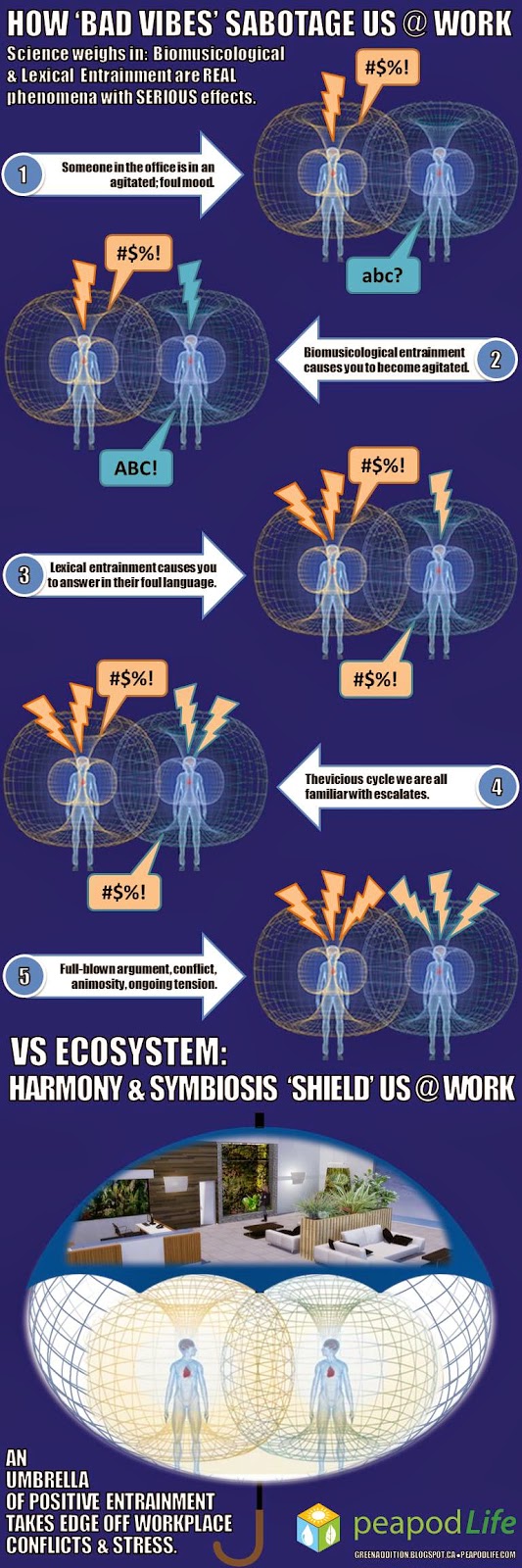
Infographic by PeapodLife: Negative Biomusicalogical & Lexical Entrainment VS. Ecosystem Harmonic & Symbiotic Entrainment at Work
We’ve all been there: the slippery slope and the downward spiral of the escalating argument. Be it at home or in the workplace, we all know the way things can get out of hand and tend to run away from us. Frustration, reactions, anger, aggression, things are said and done and…it rarely turns out well.
What we may not realize is there are real scientific phenomena affecting us during such conflicts. The fundamental principle involved is entrainment. In a general sense, entrainment is the tendency of oscillations or vibrations to synchronize.
Biomusicological entrainment is the phenomenon of entrainment applied specifically to biological organisms, including animals, human beings and ecosystems. Biomusicalogical entrainment is responsible for everything from groupthink to mob mentality.
Video: Bystander Revolution: Sam Trammell | Mob Mentality
And make no mistake; everything the above video talks about applies to adults and adult group dynamics as much as it does for children, adolescents, etc. Why? Because age has nothing to do with the effects of biomusicalogical entrainment.
Lexical entrainment refers to the phenomenon whereby individuals tend to take on characteristics of speech from others in social situations—including intonation, vocabulary, etc.
Some are more sensitive to entrainment than others, but combined, biomusicalogical and lexical entrainment have a very real impact on our relationships and on our effective use of time and energy in the workplace.
Now, compound the effects of these two types of entrainment with the toxic sick buildings and lifeless environments we typically work in—from electromagnetic radiation from office equipment to noise stress, VOC’s and other sources of indoor atmospheric pollution, the list goes on.
There’s much more than just air quality to consider. And sorry, Google, no amount of board games, beanbag chairs, foosball tables, or other manmade gimmicks can heal what is fundamentally a toxic environment, hostile to the optimum performance of living organisms…including us.
Enter PeapodLife Building EcoSystems & Technology
High order rainforest ecosystems are the BEST solution for countering the effects of negative biomusicalogical and lexical entrainment. The ecosystem acts as an umbrella, enveloping everyone in the space with a biomusicalogical entrainment field of harmony and symbiosis. Every organism—and person—within the field is constantly being entrained biomusicalogically by the infinitely complex interrelationships and balancing efforts of the superorganism in order to maximize health, wellness and optimal function of each and every individual in said field.
Image Rendering by PeapodLife: Imagine your office or workplace transformed into an atmosphere of optimal human performance, harmonic and symbiotic relationships, and health & wellness.
Now, are we saying an ecosystem will completely prevent all interpersonal conflict? Certainly not. But what it can do is take the edge off such conflicts. With the over-arching influence of the ecosystem—complete with beautiful orchids, bromeliads, soothing moss, flowing water, meditative fish, ionized living water counteracting the effects of harsh electromagnetic radiation, etc.—some conflicts might be shorter, or less intense, or more quickly resolved.
In the human body, melatonin is the hormone which is involved in the entrainment of the circadian rhythms of physiological functions including sleep timing and high blood pressure. Source: http://en.wikipedia.org/wiki/Melatonin Put another way, melatonin is the “calming hormone” in the body which counteracts the forces in us which lead to nervousness, agitation, stress, frustration, anger, etc.
Think of a PeapodLife ecosystem as constantly washing your office space in a melatonin bath. But, unlike melatonin—which can have the effect of causing drowsiness—ecosystems stimulate the senses and invigorate our energy. In addition, nature boosts the immune system, improves mental faculties, increases inspiration and imagination, and all in all makes people feel better.
Imagine fewer sick days…fewer incidents of employees waking up thinking “ugh…I don’t feel like going into work,” when work is such a pleasant place to be.
How pleasant? Videos can’t do it justice, but here’s one anyway…
Video: PeapodLife Living Wall EcoSystem Fitch Street
Now, just imagine what how all this will make you and your team FEEL? Imagine how much more you and your team will get done, and how much more pleasant an experience you’ll have doing it in the BEST indoor environment possible. PeapodLife Building Ecosystems & Technology—be at your BEST.
With these words, Director General of the BBC, Tony Hall, nailed the lid in the coffin of Jeremy Clarkson’s future hosting the wildly successful Top Gear. The dismissal relates to an alleged altercation between Clarkson and one of the show’s producers, involving a 30-second tirade and physical assault.
An investigation revealed, according to the official statement by the BBC, that the much loved presenter had “crossed a line.” Here is the official statement most fans of the show and casual onlookers alike have likely seen by now:
Video: 'Why sack your biggest global star?' Clarkson row:
Feelings of bitterness and regret were immediately expressed by fans of the show; not just online—as one might expect—but in person, via a 1-million signature petition, delivered to BBC headquarters in a dramatic fashion in keeping with the spirit and substance of the show itself.
Video: ‘The Stig’ delivers Jeremy Clarkson petition – BBC News
Cynics and critics of Clarkson’s blokeish antics might argue that the stunt by fans is exactly the kind of aggressive over-reaction which caused the incident in the first place—and not the first time Clarkson got himself into hot water with BBC brass, either.
But we at PeapodLife couldn’t shake the feeling that there’s more going on here this time ‘round. And by all means while this is just speculation on our part, given the nature of this incident versus others the embattled host has been involved in, there was almost certainly something more insidious at work.
And, in the typical way society and the media avoid the topic due to the social stigma around mental health, no one seems to really be asking an important question…
Was Chronic Stress at least Partly to Blame for now Infamous Top Gear Fiasco?
Certainly, while on the surface this seems to be a case of a much beloved television presenter “losing it” in a fit of rage with a co-worker, a little research seems to suggest there’s more to the story than that.
According to fellow TV host Piers Morgan, “just like pretty much every other 50-something in life; angst-ridden from damaged relationships, grieving loved ones, irritated by work-related issues, and battling inner demons.” Source: https://reputationrefinery.com/jeremy_clarkson
Now certainly, this is no excuse for bad behaviour—especially violent behaviour—but there seem to be more mitigating circumstances coming to light.
It turns out Clarkson had been dealing with a plethora of personal problems for some time, including a death in the family and a failing marriage. In other words, whatever triggered Clarkson to “cross the line” in professional conduct instead of on the track, was maybe just the straw that broke the camel’s back. Maybe he had been dealing with chronic stress, a condition which among the obvious rage and depression, can lead to all kinds of very real physical problems:
Are we saying an ecosystem in Jeremy Clarkson’s home, the Top Gear studio, and/or the pub where the altercation took place could have prevented the incident? Not directly, no.
What we are saying is that if chronic stress and pent up frustration and looming rage were indeed significant factors in Clarkson’s tragic fall, then absolutely: we believe the soothing, calming, relaxing and healing properties of ecosystems could have played a role in preventing this incident from ever occurring.
Forget “Captain Slow,” think MOTHER NATURE! Because there are few hugs more potent than a constant, enduring, balancing and revitalizing hug of a high-order rainforest ecosystem. P.S. To Top Gear Fans in Tanks: Life Goes On…
Of course, we must add a post script to all those lamenting the loss of their beloved presenter, now left in limbo wondering what the future has in store.
If all of you had an ecosystem in your home, business and/or school, you would have a deep appreciation for the nature of life and that all things come to an end. And, you’d be completely okay with that. You too would be relaxed, at ease, and ready to accept what could be an even more exciting and promising future.
As for Jezza? Well, love him or hate him, we have a feeling that all this is just of a setback at the end of the day…a flat tire at the side of the road or an exploding Fiat…just a tumble in a ridiculously rollie-pollie Reliant Robin. We’re pretty sure he’s going to find himself shifting into a whole new gear sometime in the not-too-distant future. After all, it’s what Jeremy Clarkson does best.
We just hope he also knows (and takes) good advice when he hears it. Our advice to him (and everyone) is this:
If there is chronic stress in your life, ask us about making the shift from the rat race and living la vita loca to the relax lane and living the PeapodLife. After all, we want what’s best for you; for everyone!
"In clinical studies, we have proven that 2 hours of nature sounds a day significantly reduce stress hormones up to 800% and activates 500-600 DNA segments known to be responsible for healing and repairing the body." ~ Dr. Joe Dispenza
Image by PeapodLife: Nature Sounds reduce stress hormones and help heal the body – Dr. Joe Dispenza
Until now, most of the studies around the healing power of nature focused on people being outside. More recently, work has been done looking into the positive effects of nature (or at least, “natural elements”) indoors.
And of course, when we refer to the healing power of nature, it follows that we also mean the preventative health and wellness benefits of nature. In other words, you don’t have to be sick to reap the benefits of nature.
In fact, a study by Health Promotional International suggests, “contact with nature may provide an effective population-wide strategy in prevention of mental ill health, with potential application for sub-populations, communities and individuals at higher risk of ill health.”Source: http://heapro.oxfordjournals.org/content/21/1/45.full.
The study, which looked specifically at hospitals, found that natural elements significantly boost the healing outcomes for patients. And the study was mostly considering picture windows which looked out onto pleasing natural scenes, like a garden, or ocean (though not many hospitals are built on seaside real estate).
It’s not just the sight of nature which is soothing and boosts healing, however. Sounds have a huge impact on our psychological well being. According to Dr. Joe Dispenza, his studies have concluded that two hours of nature sounds daily can decrease stress hormones by up to 800% and activates DNA responsible for healing and repairing the body.
Now, if just the sight and sounds of nature indoors have such healing properties, imagine what effect an actual high-order rainforest ecosystem will have.
Not only do PeapodLife’s indoor ecosystems feature absolutely beautiful flora and fauna—orchids, bromeliads, moss, African violets, tropical fish, snails, shrimp and so much more—the gentle gurgling of water in constant motion fills your ears with pure natural sounds. On top of this, the ecosystem produces fresh oxygen, cleans the air of VOC’s and other contaminants, and fills the space with an overwhelmingly positive ambiance of freshness and life.
We cannot wait for the day when PeapodLife EcoSystems are brought into hospitals and measurements taken on how much more benefit is conferred by complete high-order rainforest ecosystem, in stress reduction, healing, bodily repair, mental health, et al.