Showing posts with label Toronto. Show all posts

Tuesday, 2 June 2015

A Bed in a Box on a Bike— Dr. Seuss would approve


So you may be asking: what does a company delivering mattresses on bicycles in New York City have to do with PeapodLife and ecosystems?  Quite a lot, as it turns out. But let’s back up a moment.
When the online mattress startup Casper began selling their mattresses for $500 US each, they decided on an innovative value proposition. Using a two-ton compressor, the company stuffs their foam mattresses into a box roughly 3 feet high (104 centimetres by 53 cm by 50 cm).
That means if you live in New York City, your mattress comes delivered via bicycle; outside of NYC, regular delivery. Now, for anyone living in a condominium, small apartment, and especially a walk-up or walk-down apartment, dealing with a bar-sized fridge box can be much easier than with a queen-sized mattress.
Suffice it to say, the concept caught on with millennials and those not wanting to deal with the hassles of regular mattress delivery. Plus, it makes for great ‘unboxing videos’ online:


And fret not, Canada.
“Our plan was to expand into Canada in 2015, but we had an overwhelming amount of interest from Canadians asking if we could ship it to them, so we’re starting [in 2014],” Casper co-founder and chief executive Philip Krim said in an interview. (Financial Post)


Now you might think buying a mattress before trying it is a silly proposition. The company offers a 100-day in-home trial period. As for price, at $650 CDN for a twin and $1000+ CND for a king, Casper’s products are roughly a third less to half competitor’s mattresses made with comparable materials.

Innovation is the Key to Today and Tomorrow

If there’s a takeaway from this story it’s this: even entrenched and stayed industries like mattresses (just think back to decades of people buying their spring mattress at Sears) can be dragged kicking and screaming into the 21st Century by disruptive technologies and innovative new approaches.
PeapodLife’s mission is to disrupt the status quo of housing and building, and bring innovation to an industry that is literally thousands of years old. And despite what they’ll tell you, honestly very little has changed.  

Innovative…But Sustainable?

Delivery via bicycle certainly smacks of environmental consciousness. But there seems to be a lot of packaging that goes into one of these super-compressed deliveries. When you think about it, if you buy a regular mattress, that too comes wrapped in plastic; in fact, with the mattress compressed, Casper may even use less packaging than a regularly delivered mattress. But frankly, we just don’t know and haven’t done the hands-on research to find out.

PeapodLife, on the other hand, begins from a foundation of true sustainability—ecosystems. We can’t promise we’ll deliver your ecosystem on a bicycle, nor will we promise an exciting unboxing video (at least, not yet); but we will promise that once your high order rainforest ecosystem is installed and filling your space with good vibes and the fresh, clean air of nature, you’ll not only sleep better than you could have ever imagined, your waking hours will be that much better, too. 

Tuesday, 24 February 2015

Happy CoworkingToronto Day!
Now make it even more Productive

Image collage by PeapodLife: Coworking in a Space of Mutual Harmony and Symbiosis
“Do more than belong: participate.
Do more than care: help.
Do more than believe: practice.
Do more than be fair: be kind.
Do more than forgive: forget.
Do more than dream: work.”
~ William Arthur Ward
Source: http://www.goodreads.com/quotes/314867-do-more-than-belong-participate-do-more-than-care-help

February 24th is Coworking Toronto Day.

We think 2015 is a tremendous opportunity for coworking venues in the City of Toronto to become leaders internationally in bringing the power and beauty of PeapodLife ecosystems to their spaces. Why would they want to do that? To realize the spirit of the above quote, a spirit which is most certainly embodied in the celebration of coworking in Toronto, and elsewhere around the world later this summer.

Image: Coworking Toronto Logo

What is coworking?

The following infographic nicely sums up the topic the benefits and spirit of coworking, a concept which has been gaining popularity in the digital age as individuals working outside the framework of traditional organizational structures discover that being a freelancer or a lone wolf isn’t necessarily all it’s cracked up to be.

Infographic: Considering Coworking | Visual.ly
Credit: http://visual.ly/considering-coworking

Let’s face it: human beings are—for the most part—social animals. We like human contact (again, for the most part) and without a sense of connection we turn to unhealthy and unsustainable substitutes—including addiction, as is evidenced in the recent GenesisEcoFund blog on the subject: Could Advanced Human Habitat Prevent/Cure Addiction?

Even telecommuters and those working for larger organizations who are allowed to work from home will often seek out shared workspaces in a big to fill the “coworking void,” as it were. Perhaps it relates to the morphogenetic field that we feel more productive when surrounded by others who are being productive. Whereas being alone often means being surrounded by myriad distractions to occupy our time and attention with (and anyone who has ever worked from home can attest to this).

The benefits of coworking have been well noted. A surveys from 2012 to 2014 conducted by Deskmag revealled:

•    58% of members were working from home before joining a coworking space
•    80% of members acknowledged the business network of a coworking space had a positive impact on independent workers
•    42% of members join coworking spaces for the knowledge sharing
•    47% enjoy moral support from fellow members
•    48% often share contacts of other professionals
•    68% of coworkers report an improved focus
•    71% of coworkers report an increased creativity

Source: http://coworkingtoronto.ca/coworkingtoronto-day-2015-event-calendar/

Or, if you prefer your statistics in visual form…


Image: Coworking Infographic

Can Coworking be made even better?

PeapodLife knows so. How? With harmony and symbiosis. A Rainforest ecosystem in any shared space brings an even degree of community, collaboration, and efficiency.

Anyone who shares the electromagnetic field of an ecosystem simply starts feeling better… simultaneously more relaxed and more invigorated; a consciousness more focused and more expansive; more inspired and more imaginative. 

Don’t believe us? Just ask the tenants of 401 Bay Street, who enjoy a small ecosystem in their shared cafeteria.


Image by PeapodLife: “Angolo” Ecosystem in cafĂ© at 401 Bay Street Shared office space.

Or, the residents of the affordable retirement residence who enjoy this ecosystem in a shared living space:


And to get a feel for what the real potential contribution an ecosystem has to make on your coworking space/community, you need to read our last blog article: It’s not that easy being “GREEN” - “Efficiency” vs. “Sustainability”.

If you believe in the power and potential of coworking, and realize/accept that those benefits are taking place in toxic non-habitats; imagine what can be achieved in vibrant, transformative, dynamic coworking environments powered by high-order rainforest ecosystems…Advanced Human Habitat. 

Learn more at GenesisEcoFund.org.


Tuesday, 20 January 2015

The Changing Face of Real Estate in Toronto 2015

Video: TREB Market Report December 2014 
“The stakes are high surrounding the fortunes of the Greater Toronto Area housing market,” adds the report. “A healthy housing system is critical to a region’s economic fortunes. And with the GTA key to Canada’s economic engine, the success or failure of housing in this region carries significant national importance.”
~ TD Economics Report
$140,000 is a big number. And according to a TD Economics Report released Monday, it is the annual income needed to finance a single-family home in the GTA (which now costs about $740,000). Source: thestar.com Real Estate

The problem, as it turns out, is all that urban densification happening around the city (translation: the condo-crazy city).

New home sales are way down compared to new condo sales. This has led to a shortage in supply of homes and that has helped push prices up to the point where Toronto is nearing New York-like home costs. And it should not come at all as a surprise, according to George Carras, President of RealNet:
“This is a problem ten years in the making. … The desire to curb sprawl and encourage intensification has led to the continued condominium boom in the 416, spiking home prices and a widening price gap between low-rise and high-rise housing product.” 
~ George Carras, President, RealNet, Altus Group
Source: National Post

Image: Gap between low-rise homes and condo reaches all-time high of $251,337
Source: National Post

If something is not done, it is clear that more families will have to live in hi-rise condominiums. And, as it turns out, builders are responding by starting to offer larger condos (as opposed to the 400 sq. ft. variety designed for first-time buyers and young singles).

What to do? Clearly, new homes require land. No one wants to take the GTA back into the urban sprawl scenario which warranted the current urban intensification approach. And yet, it is all but impossible for entire neighbourhoods to be levelled to build new low-cost low-rise housing.  

What can be done?

PeapodLife is Changing the Face of Real Estate in Toronto in 2015

With our partner, Casavant, PeapodLife is able to offer benefits to each of the following:

•    Home buyers: a way to purchase, renovate and own a home they could otherwise not afford, complete with an indoor rainforest ecosystem.

Image By PeapodLife: BEST HOMES Process

•    Low-income Renters: newly renovated second-suites in good neighbourhoods, with their own small rainforest ecosystem included.

•    The City of Toronto: a practical way to achieve urban densification and urban renewal while reducing the load on aging infrastructure and services (PeapodLIfe BEST HOMES are more efficient, and utilize cisterns to capture and utilize precious rainwater for ecosystems instead of it running off into Toronto’s overwhelmed drainage and sewer system).

•    Real Estate Investors: an easy way to increase their return on investment.

Infographic By PeapodLife: $500K VS $2M => 4 BEST Homes w/Ecosystems

So, from our standpoint, in 2015 the BEST thing that can happen to the Toronto Real Estate market is PeapodLife. Why not contact us for more information and put your BEST foot forward in 2015.


Tuesday, 18 November 2014

Attention Ontario! Don’t be SAD Winter’s here,
Get Yourself a Tropical Rainforest Paradise

Image: A sidewalk snowplow clears snow in Ottawa, Ont., on November 17, 2014. (Errol McGihon/QMI Agency)

Yesterday saw Ontario get hit with the first real blast of winter with anywhere from 5 to 10cm of snow falling in some areas. The wet blanket of slushy snow made for havoc on the streets and the morning commute.

Video: Slick road conditions this morning as snow sweeps through GTA 


Today, in Toronto we are facing temperatures of -7 degrees Celsius with a wind-chill of -18! Yes, winter is here and it’s already messin’ with us!

Worst still, the Farmer’s Almanac is forecasting a worse-than-average winter—even worse than last year. And just to jog your memory, last year included intense ice storms and deep freezes.
“Winter temperatures and precipitation will be below normal, with the coldest periods in mid-December, early and mid-January, and early to mid-February. Snowfall will be below normal in Southwest Ontario and above normal elsewhere, with the snowiest periods in December and mid- to late March.”
~ Old Farmer’s Almanac 2015

Image: 2015 The Old Farmer’s Almanac

Remember what that felt like? Maybe this will help jog your memory…

Image: People walk past fallen ice-covered tree limbs along a road following an ice storm in Toronto in 2013
Credit: MARK BLINCH / REUTERS

Now, instead of all that, many minds turn to thoughts of summer, tropical getaways, all-inclusive holidays, cruises, etc. And we admit: it’s nice to get away from it all. Realistically, not many of use can get away for four months at a time, December to March.

PeapodLife can offer a practical, viable alternative to help combat what is for most “the winter blah’s” and what can be for some a very real and potentially debilitating condition known as Seasonal Affective Disorder or SAD.

According to WebMD, people with SAD exhibit many of the warning signs of depression. These can include:
  • Less energy.
  • Trouble concentrating.
  • Fatigue.
  • Greater appetite.
  • Increased desire to be alone.
  • Greater need for sleep.
  • Weight gain.
Source: http://www.webmd.com/depression/guide/seasonal-affective-disorder

A number of clinical treatments exist for SAD, including light therapy. This involves shining full spectrum light indirectly into your eyes. Other recommendations include exercise, getting outdoors, eating a balanced diet, etc.

Image: Symptoms and Treatments of SAD 

What isn’t listed as a therapy for SAD is an indoor ecosystem (of course, because there has been no clinical research done in this area yet). All PeapodLife ecosystems make extensive use of full spectrum lighting. It follows that what’s allows rainforest ecosystems to survive and thrive in what is otherwise a dark and toxic environment for them will be good for us, too.

Then there’s the fresh air and vitality we experience when sharing the electromagnetic field of a high order ecosystem. It’s not only like being outside, it’s like being in a beautiful clearing of a tropical rainforest…your very own indoor paradise, right in your own home or office. No need for expensive flights and lengthy holidays. Every day can be lived in paradise when you live the PeapodLife.

Image: Winter be damned! Everyday can be like living in a tropical rainforest paradise with PeapodLife.

So why wait any longer? Don’t let winter to continue messing with you and your emotional health. Stick it to Old Man Winter and the Old Farmer’s Almanac and start living the PeapodLife.

Visit www.peapodlife.com to learn more.


Thursday, 23 October 2014

BEST HOMES Investment Case Study


FOR DISCUSSION PURPOSES ONLY. ACTUAL VALUES MAY VARY. NOT AN OFFER.

Here’s a very simple scenario, but a target scenario for Toronto (based on an actual property available for purchase, real world renovation costs, real estate fees, etc. and greenhab investing with PeapodLife BEST HOMES Program):

House in trendy/desirable “Junction” in Toronto (nicely renovated properties sell in $1.3-1.8 million range in the Junction, usually for asking price, sometimes above asking).

Image: PeapodLife BEST HOMES Investment Case Study

The Bottom Line

In this scenario, the Investor nets out at an estimated ROI of 77%.

As you can see, PeapodLife takes a 1% commission / management fee for managing the PeapodLife BEST HOMES process beginning to end on behalf of the Investor. We are therefore incentivized to create a truly stunning home, perform outstanding marketing and promotion to and through the real estate brokers (and beyond), negotiate the best sale price, and realize savings whenever and wherever possible. This is a preliminary fee% for initial deal, and is subject to increase moving forward, based on performance.

We are certain that there are investors who will want varying degrees of involvement, etc. in the process. PeapodLife’s goal is to identify the “right” investor(s) for PeapodLife BEST HOMES. Ones who can SEE our Vision/Mission (SEE – Social, Environmental, Economic) of our consortium of partners, and who want to get on the same page with us: to make money building BEST HOMES and bringing Advanced Human Habitat to the world. We encourage any Investor to check their values against ours and that of our Non-Profit Division, www.GenesisEcoFund.org, as expressed on its website and PeapodLife’s blog: http://greenaddition.blogspot.ca.

And again, please understand that no other company in the world has PeapodLife’s ecosystem technology. Any Investor who thinks they can build something on par with a BEST HOME will soon find themselves knocking on PeapodLife’s door. Also, we have made no mention of our social housing opportunities, and commercial building concepts. We are trying to keep things simple at this stage.


Thursday, 16 October 2014

Life After Digital shows Need to bring Balance to the Dark Side

Video: How digital technology and social media impacts our lives
Credit: TVO 
“That Place…is strong with the Dark Side of the Force. A domain of evil it is. In you must go.
[Luke: What’s in there?] Only what you take with you.”
~ George Lucas via Yoda, Star Wars
Image: Social Media Hell 

Everything has a dark side. Unfortunately, there’s only one way to get past it…we have to descend into it, experience it, go through it, so we may discover something about ourselves and emerge into the light on the other side.

Digital technology and social media are having impacts on our lives no one could have ever imagined or predicted.  People are finding themselves descending into depths of darkness and depravity that are beyond disturbing—they are life-altering (in some cases terminally) experiences.

Last night TV Ontario aired a documentary: Life After Digital, which not only looked at the rise of interactive technology in our lives, but the emergence of social media and the impacts they are having on us. Some positive, others anything but.

From the tragic, much-publicized case of online predation and cyber-bullying which led to the suicide of Amanda Todd, to the emergence of “revenge porn,” the documentary obviously looked at some pretty dark extremes.

But it also looked at some of the more subtle yet ubiquitous effects of technology on our lives. For instance, the allure of the Internet as a shortcut to fame and/or fortune. Or the lingering anxiety we feel for the approval of others measured in “friends, followers, and likes.”   

You can watch the documentary online here. Also, be sure to watch The Agenda with Steve Paikin TONIGHT on TVO (Thursday 16th of October, 8pm & 11pm) for an in-depth panel discussion on the issues raised in the documentary.

Image: The Agenda with Steve Paikin 

For our part, we thought we’d get our two cents in ahead of time, by going a bit deeper into this thing called the worldwide web and ask some tough questions.

A Mirror for Humanity

For starters, is it not obvious that the worldwide web is an outward expression of the collective unconscious of the planet? Two glaringly obvious facts support this assertion of truth:
  1. Everything on the Internet came from someone’s mind at some point in time.
  2. Everything that persists on the Internet does so because it appeals to something in people’s minds. Not just one or two people, either…thousands, tens of thousands, hundreds of thousands (or more).

This is not an easy fact to swallow. But a fact it is. Wishing it were otherwise or pretending that somehow we are exempt from it does not change it. We are culpable. We are not innocent.

After all, have we not all chuckled at some Internet meme, at a YouTube “fail” video featuring the mishaps and suffering of others? Have we not all sent nasty emails or “flamed” someone in a comment?  Downloaded “free” music, movies, software, etc.? Indulged in fantasies of every kind, from real or simulated violence to real or simulated pornography to…[fill in the blanks]?

And if not, have we congregated online with like-minded individuals to point fingers, condemn all that is wrong with the world and assert our own “holier than thou” positions of being “in the right?”  

All that and more is there, online. And all that and more is here, inside our own psyche. The thing about technology is that it brings our dark side up and out of us.
“He’s more machine now, then man…twisted and evil.”
~ George Lucas via Obi Wan Kenobi, Star Wars
Image: Darth Vader Mosaic 

We are products of our environment, and we are what we eat. The more we interact with each other and the world through the mechanistic medium of digital technology and social media, the more we strengthen the binary, mechanical processes in our own psyche: black or white, yes or no, right or wrong, us or them. Action– reaction. Stimulus – response. Input, output.  Automatic. Unconscious.

There is no middle way in technology. No softness, no kindness, no compassion, nothing gentle. Forget the soothing voice of Apple’s Siri…there is no love there. Just programming. The more we engage in programming, the more programmed we become. It is a fact. It is undeniable.

And what is that programming? What is running on the program of our subconscious mind? We need look no further than the Internet: conspiracy theories, personal professional and philosophical attacks, revenge porn, identity theft, hacking, binge-watching, time-wasting, etc. Fear, anger, pride, lust, greed, laziness, etc. 

The more identified we become with technology, the more it becomes a part of us…the more it becomes us…the more we become it. We lose our humanity in the process. Don’t believe us? Just consider the new wearables and the enthusiastic anticipation—if not outright euphoria—being expressed online for the arrival of these gadgets and devices.

Image (modified): Montage of Wearable Technologies 

What’s even worse is the pseudo-esoteric talk of the “singularity” being promoted by the likes of Raymond Kurzweil and others, who actually see the evolution of humanity taking place through the proliferation of the very technologies that threaten our core values.

Is there an antidote?

There has always been a place of refuge from the monstrosities imposed on humanity which emerge from the depths of human depravity itself: nature.

Many have expounded on the virtues of nature to soothe and invigorate, inspire and insight, relax and rejuvenate, to help one reconnect with one’s true self. And we certainly don’t need to repeat ourselves for the umpteenth time. 

We will mention that in recent years, the natural havens and sanctuaries of the world are becoming an ever-scarcer resource, as multinational corporations and our voracious appetites for consumption have placed a higher valued on “natural resources” via the decimation of pristine environments.

And let’s face it, living our life at the speed of the digital age means we don’t all have the time or energy to spend walking in nature an hour a day (especially not when we have a backlog of hundreds of emails, dozens of IM’s, countless tweets, several episodes of our favourite show on the PVR we need to catch up on…not to mention the vacation pics to post and the latest version of “this or that” software to download and install).

ENOUGH ALREADY! If we can’t get away into nature, how about inviting nature back into our lives?

An indoor ecosystem fills our living space with an electromagnetic field resonating with harmony and symbiosis…the exact opposite of the vibrations we experience in social media hell.

Where social media is all often about everybody expressing their “opinions” in short, reactionary, oftentimes offensive ways, an indoor ecosystem is about experiencing the peace and harmony of who you really are. 

Where the internet is all about bringing out and feeding the darker aspects of our psyche, the ecosystem is about bringing forth and nourishing our better, brighter, Higher Self…the part of us which longs for the end of all suffering for all creatures…for calm, wellness, peace, harmony, joy and happiness.

These are the “killer apps” of an indoor rainforest ecosystem from PeapodLife.  

Image by Peapodlife: Indoor Ecoystem at Fitch Street Retirement Centre, Welland

So our answer to Life after Digital? Live the PeapodLife.

You don’t have to go live in a swamp like Yoda to surround yourself with the life-force of nature. Bring balance to the forces at work in your life. Immerse yourself in lush beautiful nature. It sure beats living on another kind of world…

Image: Death Star


Thursday, 2 October 2014

Organic Landscaping:
Better than “Man-made;” more than “Nature’s Way”


Image Collage by PeapodLife: Organic Landscaping in Bloor West Village, Toronto

“If a landscaper says they want to fill your garden with manufactured stones,
you may as well tell them to use plastic plants and Astroturf.”
~ PeapodLife  

Some may be under the impression that PeapodLife only does indoor ecosystems. Not so. We specialize in all manner of organic landscaping, from decks and patios to gardens to chemical-free pools and ecosystem ponds.

What we don’t do is “industrial landscaping,” with cookie-cutter approaches such as pre-fabricated stones which are completely lifeless. There’s a reason why the expression, “on the face of the very living rock” exists. Anyone who works with stone in any meaningful way knows that stone is alive.  Not in the way that plants and animals are alive, but they are alive nonetheless. They have energy. They have character: a face, a body, a right-side up and an upside-down. If a landscaper says they want to fill your garden with manufactured stones, you may as well tell them to use plastic plants and Astroturf.

Industrial, commercial landscaping has an overly polished, mechanical feel…like the so-called living walls of PeapodLife’s competitors…which feels like plants being forced into some manmade design schema. It becomes a kind of artificial expression. Real plants, fake rocks, a completely contrived, disconnected, disingenuous landscape.

Real stones, consciously arranged and interconnected make all the difference. Since they are interconnected, they reflect the interconnectedness of all things. Since interconnectedness is foundational to nature, they act as cornerstones. Since they are alive, they bring a garden to life:


Image: Front Yard Garden by PeapodLife featuring Rhododendrons and Real Stone

Just as ancient peoples built their incredible stone structures and monuments without mortar (even bridges that still stand today!), creating “the perfect staircase” is not about pre-fab anything, or super-expensive single pieces of rock “perfectly cut.” No. Working with stone means just that: working with the stone! Let the living pieces of stone guide you into beautiful, organic expressions of “nature’s perfect staircase.” 

Image by PeapodLife: Front Stone Staircase

If done properly, the hewn stone staircase or pathway integrates flawlessly into the surrounding garden, appearing as though it belongs there, as if Mother Nature herself intended it to be there, as if they appeared there on the landscape organically…the effect is subtle, deep and profound. It’s a feeling that is not altogether aesthetic…it reaches beyond the 5 physical senses.

Image by PeapodLife: Real stone staircase winds through backyard rock garden and leads to deck patio.

So is that “organic landscaping?” We’re sure you’ll find many approaches and definitions on the Internet, and frankly, we could care less what others’ think. What matters to PeapodLife is this: working with nature to help it achieve its highest expression, so that it can freely give back all it has to give. 

Just as indoors, it’s about creating a space of love; for in the final analysis, love is the underlying quality of all of nature: true beauty, selflessness, sacrifice, harmony, oneness, etc.

Many interpret these words to mean “letting nature do its thing” in one specific way…
Image Collage by peapodLife: Wild Gardens 

And if you like wild gardens and wild gardening, more power to you. But this is not the only way in which nature expresses itself. It is the most common way, to be sure; and largely free from human intervention—except perhaps for some forethought, selection of plants, etc.

But nature is capable of expressing itself in ways which are uncommon, require human participation / cooperation, and which result in gardens and landscapes which are not just beautiful, they make you feel special just by being there.

If we likened it to the most common of all activities in nature, sex: there is the physical act of sex with a purely physical goal (either the creation of a baby or the enjoyment of physical pleasure or both). It requires no particular connection whatsoever apart from the physical.  Basic fornication. It’s as common as can be. An industry, in fact.

Then there is making love. And at the risk of sounding clichĂ©, anyone who has ever experience this latter expression of that most natural function, sex, will attest to the difference between the mere physical act with mere physical goal(s), and intimacy which transcends the physical…an act of union which is transformed and transforming. It is much less common these days…and certainly something the sex-related industry knows nothing about and cares even less for. It is interested only in pleasure.


Image Collage by PeapodLife: Sex versus Making Love

And that’s where landscaping and gardening—like all things—are today. At one end is the manufactured, industrial approach which organizes nature into man-made eye-candy; and on the other end of the spectrum is the wild approach which creates “all-natural” landscapes which certainly look and feel as if they are completely devoid of human participation. The former is an expression of human mechanicity, the latter mechanical nature.

Then there’s the middle way…the way of lovemaking. When landscaping and gardening are no longer about creating something of aesthetic pleasure; rather, they are an experience…a labour of love for the expressed purpose of co-creating of a space of love. It’s neither cramming nature into human “design,” nor is it letting nature run amok to sow its wild oats however it sees fit.

Organic landscaping and gardening, in PeapodLife’s view, is about making a conscious connection with the very heart of nature itself—which is love—and allowing that deep connection to inform and unfold itself through a conscious co-creative process.

Image: Backyard Garden by PeapodLife with integrated sprinkler system

To make a physical space requires a physical act. To make a space of love requires a process of love-making. Most anyone who loves gardening, loves cooking, loves painting, loves just about anything creative should get this on some level, especially those who do it for the pure joy of it—not for a living.

At PeapodLife we are blessed with the good fortune of being able to offer you our joy for—and mastery of—creating beautiful natural spaces of love, even as in this case—featured in photos throughout this article—on a relatively small front / backyard in the heart of Bloor West Village.

We want you to be able to experience nature beyond the five senses…feel special just by being in your garden. All that (and more) is how PeapodLife practices organic, conscious landscaping.

Note: This garden was freshly planted and is still in-progress. Still more to come, including moss and more features. Stay tuned for updated photos.


Tuesday, 30 September 2014

Nature’s Plea: “Work with Me, People!”

Image: Spider Memes 
“When Nature has work to be done, she creates a genius to do it.”
~ Ralph Waldo Emerson

Image: “When Nature has work to be done, she creates a genius to do it.” by Ralph Waldo Emerson

Now, we’re not saying Mother Nature is a like a neurotic director on set losing her marbles at a cast and crew who refuse to cooperate with her and realize her vision of “a perfect picture.” But one must admit, given the recent eruptions and earthquakes, it may not be an altogether inappropriate comparison.

And we also must admit, when it comes to developing a healthy relationship with nature, our approach has been anything but that of a “genius.” Surely not the kind of genius Emerson is referring to.

Pesticides, GMO’s, pollution, climate change, deliberate introduction of invasive foreign species, devastation of vast ecosystems…humanity’s track record of “working with our director” comes up sorely wanting.

But there are “geniuses” out there, ones who believe it is better to work WITH Mother Nature than against her. One of them is PeapodLife’s resident ecosystem guru, Wolfgang Amelung, proprietor of Genetron Systems and inventor of the living wall ecosystem.

Here Wolfgang is featured on a piece produced by CBC’s Venture, back in the 1997, when he first took the world storm with his invention.

Video by PeapodLife: CBC Venture Report on PeapodLife Partner, Genetron Systems 
Source: YouTube - PeapodLife

Hot on the heels of the authentic work of a real genius whose passion is working with Mother Nature, a slew of so-called clever people saw the living wall ecosystem and decided “I can do that!”

The result was a plethora of so-called “living walls” and “green walls” which flooded the market and still linger today: cheap knock-offs which are chemically fed, soil-based, and don’t have any resemblance whatsoever to an ecosystem—and thus have little or any resemblance to real nature, apart from their inclusion of plants.   

And guess what? They don’t work.

Nature works because it is an ecosystem. Balanced, intelligent, able to adapt to changing conditions. Soil putrefies and dies, filling the air with more contaminants than the plants in it can clean. Hydroponic systems fill the air with chemicals and fertilizers. Neither systems are capable of producing ionized living water, and both types of systems suffer from mold and mildew problems due to the moisture.

But wait! Don’t PeapodLife Living Wall Ecosystems also produce a lot of moisture?

Yes they do, but our ecosystems produce ionized living water—negatively charged ions—which suck contaminants out of the air. The electromagnetic field of an ecosystem is balanced, meaning mold is kept in check. What flourishes in its place is moss—a feature no other so-called living wall is able to duplicate.

PeapodLife ecosystems were developed and patented by a true genius who knows the benefits of working with nature—not against it. Now those benefits are available to you: in your home, workplace, school, retirement centre, wherever wellness, calm, clarity and wellbeing are of importance and value.


Tuesday, 29 July 2014

Toronto Condo Market: what’s REALLY going to Happen?

Image by PeapodLIfe: Screenshot of Google Search “condo market toronto crash”
Source: Google
“I’ve been perplexed about that for a couple of years.”
– Prof. John Andrew, Queen’s University
Source: TheGlobeandMail.com: Reading Toronto’s real estate market is no easy task

It’s ridiculous, really. We offer the above screenshot of a Google search to demonstrate how there are as many differing opinions on the state of the condo market in Toronto as there are condo developments under construction.

So what’s really going on? 

I had an interesting meeting yesterday at my favourite cafe, The Good Neighbour coffee shop in the Junction. My companion was an experienced provider of business services to Toronto condo developers.

“Their worried,” began my newly found friend (who shall remain anonymous). “I mean, you would be too if you’re sinking millions into your development and across the road you see XYC Corporation breaking ground on a 300-unit high-rise.”

“And these guys spend millions of dollars on marketing, public art, anything to differentiate their products.” 

“Really?” I thought. Anything?

Image by PeapodLife Partner: Genetron Systems Living Wall Ecosystem, former Club Monaco Head Office

If there’s one thing we know about our ecosystems, is that you can't put a price tag on the “wow!” factor they induce in people when they first experience one.

Forget public art. You’ve seen it once; you’ve seen it a thousand time. A condo developer can spend hundreds of thousands of dollars on a giant piece of metal (or whatever) which will only ever be one thing: a giant piece of rusting metal (or deteriorating whatever).

An ecosystem is different. An ecosystem is alive. It grows, changes, adapts, and flourishes. There’s always something new to see. There’s always new discoveries to be made.

An ecosystem fills the air around it with a freshness and an energy that no piece of art can match—David and other works by the great masters notwithstanding (but what condo developer is springing for the equivalent of David?)

Image: Let’s face it, you won’t be seeing anything close to Michelangelo’s David in a Toronto Condo anytime soon.


But condo developers can still have a masterpiece in their buildings—what few low-rise or mid-rise condos can match and even fewer competitors will have—a beautiful PeapodLife ecosystem.

The best part, PeapodLife can install a compact, fully-functioning 5-biome ecosystem in sales offices and model suites, along with high-detailed renderings of what the ultimate full-size ecosystem will look like.

The result? Potential condo buyers don’t have to rely solely on renderings or their imagination. They can actually experience the freshness and energy of an ecosystem first hand, and let their imagination run wild as they see images for the full-size system.

Image Collage by PeapodLife: Small Unit to Big Ecosystem in your Condo Development

The bottom line is this: no one knows what’s really happening with the Toronto condo market, but PeapodLife knows what needs to happen if condo developers want to truly differentiate their product in a tightening marketplace with waning demand.


Thursday, 1 May 2014

Is WiFi in Canadian National Parks the Future of Nature Appreciation or just a Digital Distraction?

Video: Parks Canada wants to install wireless internet access hotspots at up to 50 of its parks this year

"My thoughts can be expressed quite simply. I think it is a disastrous, quite stupid, idiotic concept, and should be eliminated immediately."
~ Farley Mowat, author, environmentalist, activist, one of Canada's most widely read authors

"I think the idea of WiFi in the national parks is great…if you don't want to partake just don't bring your phone. It might even get people out to the parks who otherwise wouldn't go.... they'll probably hopefully get distracted by all that nature."
~ Kathy Daley, camping enthusiast from Winnipeg
Source: cbc.ca: CBC Radio The Current with Anna Maria Tremonti: WiFi in some of Canada's national parks gets a fuzzy reception from campers

It’s a fair question, is it not? Quite a divisive question in fact: one which seems to be causing quite the stir not just in certain circles, but among the general public. Is Wi-Fi in Canadian national parks the future of nature appreciation or just a digital distraction?

The point—that we are living in a digital age and that internet access might make national parks more palatable to a new generation of young, wired Canadians—on the surface has its merits. Why not entice young people away from their cloistered computer screens to experience the great outdoors?

The counterpoint was summarized well by Stephen Sharper, columnist for The Toronto Star and an associate professor of the School for The Environment at the University of Toronto in a panel discussion on CBC Radio’s The Current with Anna Maria Tremonti:
“Children who often suffer from ADHD, from suicidal tendencies, and depression often improve dramatically when exposed to nature. And it doesn’t have to be a wilderness experience, it can be a visitors’ centre at a national park. But it’s direct experience with nature, not mediated through computers or Wi-Fi technology…[which] is very salutary and very important for the psychology and physical wellbeing of our children. And anything that can enhance that and foster that, I think, is to be promoted.”
~ Stephen Sharper, School for The Environment at the University of Toronto
Source: CBC Radio’s The Current with Anna Maria Tremonti

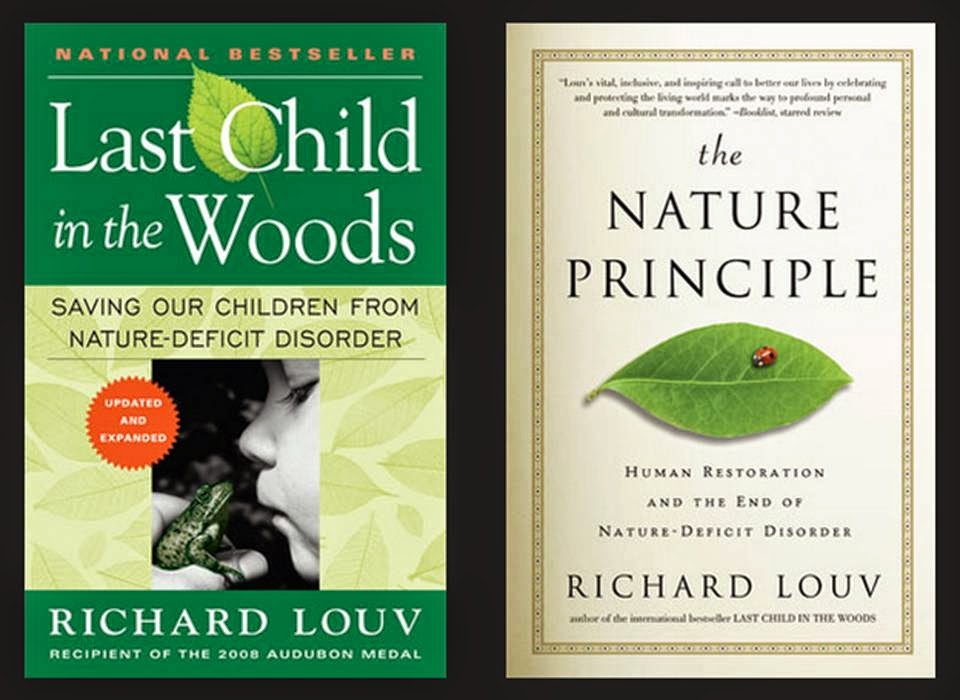
Mr. Sharper made his comments in reference to the work on Natured Deficit Disorder or NDD, pioneered by Richard Louv and featured in his books Last Child in the Woods: Saving our Children from Nature Deficit Disorder and The Nature Principle: Human Restoration and the End of Nature-Deficit Disorder.


Richard Louv is not only a journalist and author of eight books about the connections between traditionally recognized human institutions of family and community with nature. He received the Audubon Medal in 2008 and the Cox Award in 2007. In his newest book, The Nature Principle, Louv offers readers:

“a new vision of the future, in which our lives are as immersed in nature as they are in technology. This future, available to all of us right now, offers better psychological, physical and spiritual health for people of every age.” 
Source: richardlouv.com: About Richard Louv

What does PeapodLife think about all this? It’s quite simple, really: nature represents the gateway to a whole other kind of “network,” one which the Internet can scarcely hold a candle to…an UNLIMITED SOURCE of KNOWLEDGE; an INFINITE WEALTH of BEAUTY, INSPIRATION, IMAGINATION and PEACE.

Our previous blog article, Nature’s Perfection Recorded Beautifully: Birds on The Wires is Music to Our Ears attempted to illustrate how nature has in the past inspired geniuses throughout time and in every area of human endeavour—and continues to  do so. “But for how long?” is the question we posed.

And we pose it again: how long will nature serve humanity as a gateway to “the cosmic web” if our last bastions of pure, unadulterated natural splendour become infected by the mechanical, technocratic paradigm?

What marvels of inspiration, what deep, world-changing insights will be lost to another level of Angry Birds or Candy Crush Saga?  What precious once-in-a-lifetime opportunities will be lost forever because the individuals “present” were more concerned about taking a selfie and posting it to Instagram than being truly present to witness the miracle of nature unfolding before them?

PeapodLife believes wholeheartedly in the work of Richard Louv and others, but we take it to a whole new level. It’s not enough to occasionally expose ourselves and our children to nature. We must learn to live in harmony and mutual symbiosis with nature again.

This means submerging ourselves into the energetic field which only ecosystems generate; surrounding ourselves in our daily lives with healing, calming, rejuvenating and inspiring energies. We know that by doing so, this question of Wi-Fi in national parks will simply go away. We won’t need it.

In fact, we may begin to find ourselves relying less on Wikipedia (and the like) and more on our own innate (but currently atrophied) abilities to access universal knowledge.

Image: There is no Wi-fi in the forest, but I promise you will find a better connection
Source: facebook.com: Echoes of the Heart Healing: Album:Mobile Uploads: Grateful for Higher Connections


Tuesday, 15 April 2014

It’s Quality of Life, NOT Quantity of Life:
Downsize Your Upscale Lifestyle to a Life of Substance (with plenty of Style)

Image by PeapodLife: Your Quality of Life wants its Perspective Back.   
Mansion Images Source: mansionproject.blogspot.ca: The Mansion Project - Bridle Path, Toronto, Canada - Part 2
“Giving up a home we were so proud of, I was expecting more condolences for the death of my upper middle class lifestyle, but friends wondered if they could get rid of all the clutter that bogged them down too. I was feeling shame for sure... but little by little, after three garage sales and a few trips to Goodwill I realized that material goods are not my identity. Making a massive difference in the world and keeping my family intact, much higher calling.”
~ Julie Kantor
Source: huffingtonpost.com: Huffington Post: Home: Julie Kantor: 5 Things I've Learned From Downsizing Our Lives -- Part 1

We’re not the first to talk about downsizing your lifestyle, and we certainly won’t be the last. From The Huffington Post series by Julie Kantor to an article on Scaling down a retirement lifestyle by Sonya Stinson on Bankrate.com, many smarter and more eloquent individuals have expounded on the many virtues of downscaling your lifestyle.

And while Julie and her family moved into a rental apartment, we at PeapodLife don’t necessarily believe one has to take such drastic steps to achieve the same goal. On the contrary, we have what we believe to be a unique take on the whole downsizing your upscale lifestyle to a LIFE OF SUBSTANCE.

If you’re living in the Greater Toronto Area, chances are your upper-middle-class home is worth in excess of a million dollars, and likely several million. The real estate market is very hot in Toronto these days, and there may never be a better opportunity to “sell high.”

But let’s say you do sell? You still have to buy another home. How will it be different? Also, what will you do with the excess cash? Where will you invest it? So long as you’ve lived in your home a number of years there’s no capital gains, but there are important financial considerations to make.

What if you could live in a green dream home and build 9 more like it for others to live in? You could sell them, rent them, or let PeapodLife’s Property Management Partners manage them for you.

You’re still invested in Real Estate, but no longer tied to a single enormous house you don’t need. Instead, you’ve diversified your real estate investment and are helping lower- and middle-income families also live in healthy green dream homes with PeapodLife ecosystems.

So, let’s be practical and walk through PeapodLife’s process step-by-step complete with some numbers. To keep it simple, we’ll work with a net house value of $2.5 million (after all real estate commissions and fees and any mortgage balance outstanding on the property; this is a fair number in today’s Toronto market for an upper-middle-class home).

   •    House worth $2.5 million (cash on hand after sale)
   1.    Get pre-approved for 10 mortgages of roughly $1 million each ($10 million total).
   2.    PeapodLife’s Affiliated Realtors locate 10 “sub par” properties (fixer-uppers) with one in a desirable neighbourhood you wish to live. All 10 (or just 9) can be selected on the basis of being able to be turned into duplexes with legal 2nd Suite Basement Apartments (income properties). Conditional offers are made on the properties.
   3.    PeapodLife’s Affiliated Architectural Technologists Inspect Homes, plans changes, prices out improvements including cost of high-order rainforest ecosystems on all 10 properties. Each property, cost of home + green renovations including ecosystem comes to less than $1 million.
   4.    Close on homes; roughly $250K downpayment on each ($2.5 million total, or cash on hand after sale of upscale home).
   5.    PeapodLife Affiliated Performance-bonded Contractors do the renovations & PeapodLife installs ecosystems.
   •    You are now the proud owner of 10 sensibly designed Green Dream Homes, 9 of which are income properties, all of which feature the healthiest, most vibrant, beautiful and stress-free living environment imaginable: PeapodLife BEST HOMES…Building EcoSystems & Technology via Home Ownership for the Masses that’s Economical & Social.
   •    You can rent, sell, or gift to your children any of the 10 BEST HOMES…whatever you choose. But make no mistake: you’re the hero here: you’ve transformed 10 run-down old houses into 10 green dream duplexes, all with legal basement apartment dwellings unlike anything else in the GTA.

So long as you can carry the mortgages, you can wait for bidding wars to break out on any of the properties (which is not unheard of in today’s market). In the meantime, you can hand over the Property Management to PeapodLife’s Real Estate Partner and either earn an income (or at least carry the mortgage).

Or, if you want a real life of substance, you can price the homes fairly (which still gives you an R.O.I. of $125K per house, or 50% ROI) and give 18 families (9 x residences) access to affordable green dream homes, knowing you’ve helped rejuvenate aging buildings in Toronto, and progressed the Green Building Movement.

PeapodLife’s BEST HOMES: Green Dream Homes in 5 Easy Steps 

No matter how you look at it, it’s a win-win-win. No matter how you slice it, you’ve downsized into a life of REAL SUBSTANCE, with the healthiest, stress-free living space for you, and for 18 other families in your community.

Email us today to get started: info@peapodlife.com.