Showing posts with label nature. Show all posts

Thursday, 28 May 2015

Beyond Hierarchy: Six Short Films Exploring Self-Organization


Today we are offering some short films on hirarchy and self organization, for the sake of discussion.


Video: Introduction to Self-Organisation Beyond Hierarchy
Source: YouTube https://www.youtube.com/watch?v=v-g6pRxkwUI

That’s just the introduction to the series. So let’s dig into the first piece, culture:

Video: Creating Culture: Self-Organisation Beyond Hierarchy

Now, if you made it through part one without your eyes glazing over, congratulations! But wait, there’s more…

Video: Finding Fit: Self-Organisation Beyond Hierarchy

In this part, the obvious allegory used is that of nature in relation to the broader environment that organizations are a part of. The example used is that of a “fish in water” or “a fish out of water.”

The film proceeds with a mind-numbing intellectual elaboration on this grossly reductive view of nature: that organisms have needs which they take from the environment.  This is an anthropomorphized view of nature!

One cannot say “understanding natural systems is the way” and then anthropormize those systems, then say you are learning from nature!

Anyway, we are not going to make you watch all six parts of this series. Why? Because it’s an absolutely futile and useless waste of time; a mind-numbing intellectual exercise trying to solve a problem that was created by the very thinking that is being used to try and solve it.

Watch all Six parts at Films for Action: Self-Organisation Beyond Hierarchy

Flawed Thinking will never Solve Anything

Self-organization is not the antithesis of hierarchy. Hierarchies are everywhere in nature!  Hierarchies self-organize all the time. Even in human group dynamics, hierarchies can form organically, whether or not the individuals involved are cognizant of these formations or not.

Intellectualization and defining this structure versus that structure is so limiting, so reductive, so unlike anything which happens in nature—and this series of films likes to use the word “reality” and “complexity” a lot—that it is not going to answer the questions being asked and the problems being raised by this series of films.

So what will?

For starters, how about comprehending what self-organization actually is, and how it works? No, not intellectually, not theoretically, but PRACTICALLY. How do you do that? By becoming a part of a self-organizing entity. Now, since we are grossly unconscious of the self-organizing phenomena occurring in our own bodies, our only other recourse is to become conscious of self-organizing phenomena around us.

Start with getting an ecosystem.

Whether you realize it or not, when you are in an ecosystem’s field of influence, you are actually part of that ecosystem.  As it self-organizes, so you are being self-organized. As it seeks balance, so you are being balanced. As it assumes a posture of harmony and mutual symbiosis, so you are being harmonized and receiving the benefit of that symbiosis.

And how do you respond? As you imagine you might; unless you are cold-hearted, closed-minded, oblivious and uncaring, in which case no system of self-organization will connect consciously with you. An ecosystem will still try to “get through to you,” but even in nature, cancers and toxins exist. So, too, corrosive people and toxic attitudes can sabotage the best intentions of any effort at self-organization.

The point is, self-organization is intuitive. It is energetic, extra-sensory, and organic. Self-organization is not materialistic, and anything but intellectual! Trying to theorize your way through models of self-organization is like trying to understand infinite complexity. You can’t. No one can. The mind cannot grasp it. Nature doesn’t function that way. Nature senses, feels, intuits, and interprets flows of energy and influence. The physical reality we see is just the coarse veneer to what’s really going on. 

If you really pay attention to group dynamics and human interactions, you will see that it’s very much the same for people. We can feel good vibes and bad vibes in the workplace; and individual dynamics functioning on a base level independent of perceived or established social structures can be explosive.

Attempting to self-organize without the presence of an ecosystem is a recipe for disaster because the natural tensions which arise in the self-organizing process are effected by the immediate environment. In most organizational environments, lots of harsh, negative energy is bombarding participants—from fluorescent lights to computer screens to toxic off-gassing from industrial building materials and carpeting to VOC’s, noise pollution, the list goes on and on. 

An ecosystem provides the prerequisite for successful self-organization: harmony and mutual symbiosis; such that even self-organizing hierarchies, which in nature often require violent confrontation, are quickly calmed-down and dissipate once the selection process is complete. In the human context, disagreements and conflicts will arise. But an ecosystem is able to “take the edge off”.

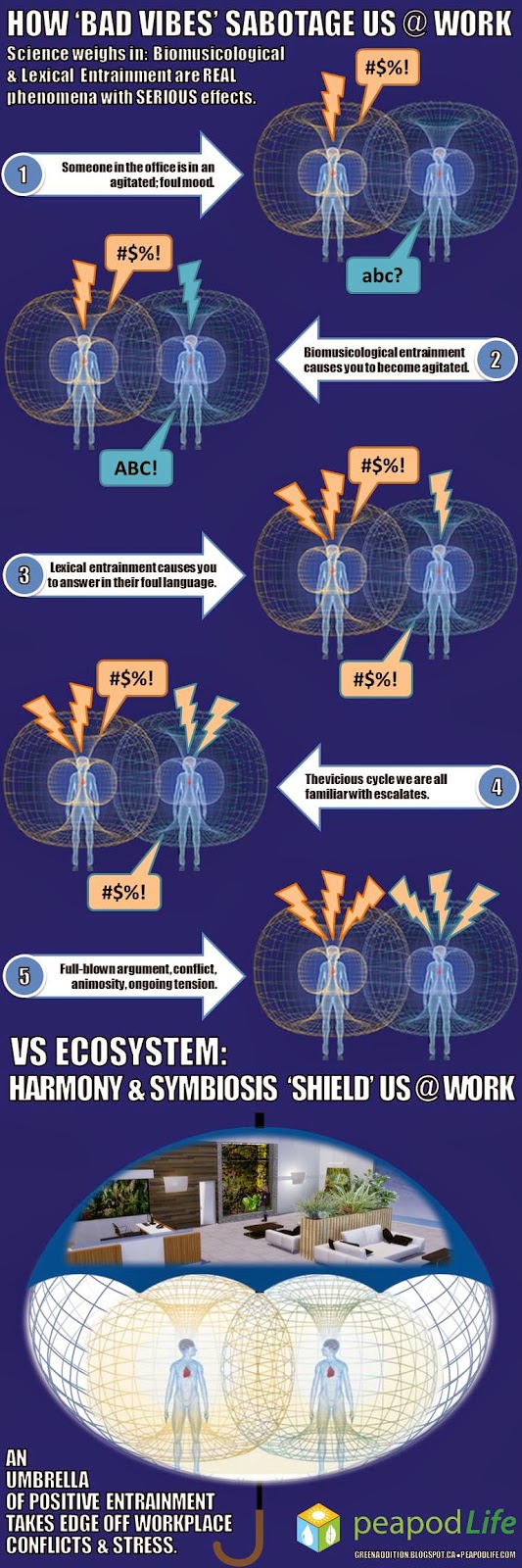
Please refer to the following infographic: 


Again, here we see how the best of intentions related to self-organization are hamstrung without the power of an ecosystem.

Ecosystems are not the only way nature self-organizes; but they are the most powerful expression of the underlying process of self-organization which we can interact with in an everyday sort of way. In other words, the earth is a self-organizing biosphere, but is far too vast for us to interact with as biological creatures in totality…we are mere specks compared to it. No, ecosystems are the natural, biological phenomena which we can best relate to and be a part of.

It is precisely the oneness we can experience with ecosystems which can inform our relationships, groups dynamics, organizational behaviour and evolving organizational structure; as we attune ourselves intuitively to our inner ecosystem, and thus expand our sensitivity from an organizational perspective to the outer ecosystems of community, economy, business environment, etc.

The Bottom Line

The intellect cannot, will not, and should not attempt to understand infinite complexity. It’s not its job. It was never designed for that task. The consciousness is another matter entirely. It can, should and with patience and discipline will comprehend the nature of infinite complexity. But only through direct experience, and only with little baby steps.

Self-organization is the product of countless billions of organisms playing out conscious interrelationships defined by harmony and symbiosis. Even if sacrifice and death appear on a regular basis, these too are a part of that self-organizing process of renewal, evolution and devolution.

Unfortunately the mind doesn’t like dealing with sacrifice, death, conflict and other “messy” aspects of self-organization. It wants everything to be sanitized and controlled…like a Swiss watch or an iPod.  But watches and machines are designed. They do not; cannot self-organize.

To be comfortable in your own skin, to be comfortable in an ecosystem, to be one with the “messiness” of self-organization and evolution, going with the flow of events and not trying to control the process all the time…these are the keys to organic growth and evolving a self-organizing entity of harmony and mutual symbiosis. Having an ecosystem on site can make all the difference.


Tuesday, 12 May 2015

Photos Reveal our Planet is more Incredible
than any Fantasy; more Breathtaking than Sci-Fi

' Tis strange - but true; for truth is always strange;
Stranger than fiction; if it could be told,
How much would novels gain by the exchange!
How differently the world would men behold!
How oft would vice and virtue places change!
The new world would be nothing to the old,
If some Columbus of the moral seas
Would show mankind their souls' antipodes.
Image: Monte Roraima, Venezuela 

Today, something a little different.  We came across a dynamic list of the 30+ unbelievable places that look like they’re from another planet and decided to share some our favourites. Some of these photos look down-right alien, but make no mistake: they are for the most part untouched photos of actual places right here on our planet.

Image: Glowworms Cave, New Zealand 


Image: Tianzi Mountains, China 

So what’s the point of sharing these photos? Well for starters, it is important for us to realize that even these seemingly bizarre and other-worldly locales are both host to an ecosystem and themselves part of a larger ecosystem—in fact, the biosphere of the entire planet. It just goes to show how diverse ecosystems be and how extreme lengths nature has to go to in order to exist.

Image: Naica Mine, Mexico 

Image: Giant’s Causeway in Northern Ireland 

There is no question these photos also ignite the imagination. If any of these locales seem familiar to you, it’s likely because they have inspired settings in popular fantasy and science fiction films and television programs.

Image: Fly Geyser, Nevada, USA 

Image: Zhangye Danxia Landform in Gansu, China 

There is also an unquestionable beauty to these locales. Inhospitable as some may be to us, they are nonetheless compelling in their strangeness, wholly encaptivating…and not just visually. It is with absolute certainty that we can state as amazing as these photos may be, they do not, cannot hold a candle to actually being there and experiencing such expressions of nature in person.

Image: Emerald Ice on Baikal Lake, Russia 
Credit: Alexey Trofimov 


Image: Son Doong Cave, Vietnam 
Credit: National Geographic 

No doubt the growing popularity of eco-tourism is one of the reasons these photographs even exist. Human beings are explorers by nature. It’s not only that we crave novelty; we long for knowledge…and not just the knowledge we get from reading books or watching documentaries. We long for experiential knowledge. There is nothing like having being there, done that no matter where “there” may be, and no matter what “that” was.

Image: Glowing Beach in Maldeves 

Image: Salar De Uyuni, Bolivia 

The question is, can we experience a taste of that exploration and discovery in our everyday lives without having to spend all the time, money and effort to take a trip to a far off land? Is there a way to experience the excitement, wonder and beauty of new discovery in our home, workplace, school, wherever we live, work or play?

Image: Dallol Volcano, Ethiopia 

Image: Ice Cave near Mutnovsky Volcano, Russia 

The answer is YES.

Consider this: no matter how spectacular a location may be, you get to experience it for a few days—possibly weeks. Unless you are very lucky and supremely committed, you will very rarely ever get to experience the changing face of such locations over time. After all, nature is not static. Nature grows, changes, adapts. A snapshot in time will only ever be just that…a memory.

Image: Spotted Lake, Canada 

Put another way, eco-tourism and travelling to the ends of the earth to witness the oddities and extraordinary wonders of the natural world will not result in a deep relationship between you and those places. They may result in vivid memories in your mind, and perhaps a pining in your heart to return someday, but you will not have a deep comprehension of the rhythms of those places, the ongoing harmonic effects of being there throughout the seasons, nor the wonder of watching these incredible expressions of nature adapt, evolve, grow and/or even die.

But with an ecosystem from PeapodLife, you CAN. And although we can’t promise you a landscape like that in these photos, we can promise there is ALWAYS something new and exciting in our ecosystems. Whether it’s an orchid blooming, moss growing, plants advancing, others receding, fish bearing young, snails multiplying, you get to watch your own “interior landscape” grow and evolve and both respond to your moods and improving your moods.  We hesitate to say life with an ecosystem is more similar to having a pet than a garden, but many who live with an ecosystem describe it that way.

The truth really is stranger than fiction. When you really think about it, that means the promise of nature is not to bring biology into your life but magic. It’s just another aspect of Advanced Human Habitat for you to EXPLORE.

Image: PeapodLife: Explore Our Advanced Human Habitats


Thursday, 30 April 2015

ECOsystem, ECOlogy, ECOnomy
It’s all about “How We Live” in our HOME

Image by PeapodLife: ECO=HOME
Image Credit: Earth Nature Vector House & Ecology Graphic 
“There's only one corner of the universe you can be certain of improving, and that's your own self.  So you have to begin there, not outside, not on other people.  That comes afterward, when you've worked on your own corner.”
~ Aldous Huxley, Time Must Have a Stop
Let’s start with the following short film entitled ‘How We Live – A Journey Towards a Just Transition’ by Kontact Films, paying close attention to the first few minutes of the film discussing the definition of ‘eco’ as it relates to ecosystem, ecology and economy.


So let’s break it down once more:
  • Eco = home.
  • Ecosystem = the complex interrelationships of home.
  • Ecology = the study & knowledge of home (self-knowledge, where ‘home’ is an individual).
  • Economy = the management of home.  

And there are three pillars of economy…
  1. Resources
  2. Work
  3. Culture
Now, the film goes on to describe new business models, more democratic ownership, more local ownership, and even starts discussing human consciousness in terms of human behaviour, actions, interactions, “living better,” etc.

But sadly, while the film “gets” that we cannot expect the banking system which got us into this mess to get us out of it, the film ignores its own axioms in prescribing more top-down structural thinking as being the source for a plausible solution.

Nature doesn’t do much from a top-down level. The term ‘seed change’ comes from this very notion of incremental organic change. The planting of a seed which over generations produces not only one tree, but a forest of trees; the pebble dropped into the pond sending out ripples over time.

Now consider all the so-called “green” movements and technologies related to energy conservation, recycling, etc. At the end of the day, these reduce our negative impact on the planet, but do they actually heal our relationship with the planet? What does it mean, to have a relationship with nature?

How can we propose to create a mindset within ourselves—or a culture within our companies, let alone society—aligned with long term sustainability on the planet, if we have no idea what living in harmony and mutual symbiosis actually feels like?  In other words, no practical, experiential knowledge?

We cannot hope to better manage the resources, people and culture of economy unless we experience what it means to live in an ecosystem. Living in an ecosystem, gives us the experiential knowledge we need we truly comprehend the meaning and dynamism of harmony and mutual symbiosis—what we call ecology—and how it relates to our own self-knowledge.

Building upon such a nucleus, such a seed, we can adapt and grow an economy based on harmony and mutual symbiosis… exactly what we experience day in and day out at home—in our homes, offices, schools, as a reflection of what we’re experiencing in our hearts and minds.

In synthesis, we become a part of actual ecosystems…we gain authentic ecology through experience…and our economy cannot help but reflect everything we are and everything we know.

Image by PeapodLife: Explore Our Advanced Human Habitats with a pPodLite Angolo Unit perfect for Home & Small Office

It doesn’t take much, truly. Even a small pPodLite Rainforest Ecosystem from PeapodLife is enough to begin transforming your home/office into a place of harmony and mutual symbiosis…begin giving you the experience of what being in alignment with nature feels like.

Then the real magic happens. But you wouldn’t believe us if we told you! Like all believers in the magical powers of nature to inspire, transform and heal, it’s something you simply know in your heart, and/or have to experience first-hand for yourself. 


Thursday, 23 April 2015

Post-Earth Day Decompress:
Our Favourite Facebook Pages

Image Collage by PeapodLife: Our FB Fav’s Featuring Screenshots of The Rainforest Site & Nature Heals, Nature Reveals
“But I give best when I give from that deeper place; when I give simply, freely and generously, and sometimes for no particular reason. I give best when I give from my heart.”
Yesterday was Earth Day, and as such you may have found yourself inundated by Earth Day messages. From hard-hitting, guilt-tugging proclamations to soft-spoken, heartfelt meditations and everything in between, Earth Day is the one day in the year ‘the gloves come off’ for environmentalists, and just those who care deeply for nature and the wellbeing of the planet and all beings.

Fittingly, we couldn’t help but share our Earth Day Reflections via Genesis Eco Fund’s blog. But that was yesterday. Today, we offer a completely different take as a kind of ‘decompression’ after all the intensity and passion of earth day.

Facebook: love it or hate it, the mother of all social networking sites has redefined what it means to ‘like’ and ‘share.’ So today, PeapodLife wants to share some of the Facebook groups it likes with you.

The Rainforest Site

The Rainforest Site is a non-profit organization dedicated to raising awareness, appreciation and knowledge about the natural world, and the weird and wonderful creatures who share this planet with us. From the profoundly serious and awesomely powerful to the utterly beautiful and heart wrenchingly adorable, The Rainforest Site never ceases to provide a steady flow of nature’s finest and funniest.

Take this post about Bao Bao’s fun frolic in the snow…

This is the most precious thing everrrr <3
Posted by The Rainforest Site on Thursday, April 23, 2015


Or this post about baby sloths…


How much do you know about these adorable creatures?? :)
Posted by The Rainforest Site on Thursday, April 23, 2015


But it’s not just ‘cute’ posts that The Rainforest Site features. There’s this very recent post about the volcanic eruption in Chile:


Have you seen the volcano that just erupted in Chile!?
Posted by The Rainforest Site on Thursday, April 23, 2015


Or this post about Conservation International’s film ‘Mother Nature’:


Your mother has something to talk to you about this Earth Day <3
Posted by The Rainforest Site on Wednesday, April 22, 2015

And the many simple yet profoundly beautiful images from the world of nature (not just the rainforest):

Gorgeous creature!
Posted by The Rainforest Site on Tuesday, April 21, 2015

For their wonderful work educating and sharing all there is to LOVE about the natural world, The Rainforest Site gets a big ‘like’ from PeapodLife.

Nature Heals, Nature Reveals

This Facebook Community is all about sharing the simple, the beautiful and the profound. If there is a place on the Internet which captures the essence of the last stanza of Ode on a Grecian Urn
"Beauty is truth; truth, beauty—that is all Ye know on earth, and all ye need to know."
…Nature Heals, Nature Reveals is that place.

Admittedly, some of the sentiments, posts and quotes they share will not always be everyone’s cup of tea (cynics and anyone repulsed by anything that sounds ‘too new-agey’ be warned), it’s undeniable that there’s something inside all of us which cannot help but be moved when confronted with images and words like the following…

Trees are sanctuaries. Whoever knows how to speak to them, whoever knows how to listen to them, can learn the truth....
Posted by ॐ Nature Heals, Nature Reveals ॐ on Wednesday, April 22, 2015

It is almost a shame to introduce each of these…extra words are somehow just a diminishment of the beauty, wisdom and simplicity each imparts to us:

The Secret of Strength lies in the Quiet Mind...~ Grace Cooke~ Image by Zulus77
Posted by ॐ Nature Heals, Nature Reveals ॐ on Wednesday, April 22, 2015


Just become quiet, still, and solitary, and the world will offer itself to you to be unmasked; it has no choice. It will roll in ecstasy at your feet.~ Dana Hawksister~ Image by Lars van de Goor
Posted by ॐ Nature Heals, Nature Reveals ॐ on Tuesday, April 21, 2015


Being silent for me doesn't require being in a quiet place and it doesnt mean not saying words. It means, "receiving in...
Posted by ॐ Nature Heals, Nature Reveals ॐ on Tuesday, April 21, 2015


Fresh beauty opens one's eyes wherever it is really seen.~ John Muir~ Image by Valerie Monthuit
Posted by ॐ Nature Heals, Nature Reveals ॐ on Tuesday, April 21, 2015


And of course, like many other Facebook pages, Nature Heals, Nature Reveals shares the best of the best of others as well…


Beautiful! ~ Thank you Rhythm of Peace: Cultivating Peace in Daily Life! ♥
Posted by ॐ Nature Heals, Nature Reveals ॐ on Tuesday, April 21, 2015


We could certainly go on, but instead, perhaps will just provide a link to their PHOTO GALLERY.

What we love most about ॐ Nature Heals, Nature Reveals ॐ is that it comes close to capturing, in images and words, the essence of Peapodlife—if not quite the feeling you get from a PeapodLife ecosystem.

The simple sentiment, ‘nature heals, nature reveals,’ beautifully captures the essential benefits of inviting a high-order ecosystem into your home, workplace, school…wherever life demands you to spend the majority of your time.

It would be wonderful if we could all spend the bulk of our days out in nature, contemplating its beauty and meditating under its gaze, relaxed and able to receive a gift from its infinite wellspring of inspiration and imagination. But the reality of our lives is quite different; and the stressful, toxic indoor environments we are forced to inhabit are pretty much the antithesis of that dream of oneness with nature.

PeapodLife brings that dream to life once more; and brings the healing, inspiring and revealing power of nature into our lives where we need it the most…precisely where we currently have it the least.

Honourable Mentions and Final Thoughts

We don’t share everything we find on Facebook on our own Facebook page – PeapodLife Building Ecosystems & Technology – but we do try to share things that reflect our values and the spirit, essence and feeling of PeapodLife ecosystems.

That is why we often share posts from The Amazing Wild Nature, National Geographic and all other groups/posts which have grabbed our interest and attention over the years.

And of course, liking/following us on Facebook is one of the best ways to stay informed about us, featuring blogs and other original content related to ecosystems and living a happier, healthier, more peaceful and productive life…the PeapodLife.


Tuesday, 7 April 2015

Bring the Mind Home at Last
with an Ecosystem in the Home First

“All of man’s difficulties arise from his inability to sit quietly in a room by himself.” We do so many things, we speak volumes, and we think an endless amount of useless thoughts, but we’ve lost the sense of being. We’ve lost our ground. The most important thing is presence. Being. We’re often so distracted that: “We’re scattered everywhere, but nobody is at home.”
~ Blaise Pascal, with Sogyal Rinpoche
Source: School of the Holy Science Facebook Page:

The French philosopher Pascal once said, “All of man’s difficulties arise from his inability to sit quietly in a room by...
Posted by School Of The Holy Science on Tuesday, April 7, 2015


Let’s face it: very few of us can sit quietly in a room by ourselves. For so many reasons, both internal and external, we find it very difficult to just be still with ourselves.

Whether it’s the cacophony of our crazy busy mind, our crazy buy life, or the mixed-mash-up of real and perceived distractions pulling our attention in all directions, we find ourselves living in a kind of hurricane; a typhoon of never-ending thoughts, worries, wants, to-do lists, etc.

Like a song that gets stuck in our head, we cannot escape the prison of “mental calm depravation.” We may even have difficulty sleeping; either unable to fall asleep due to the never-ending stream of thoughts troubling us and keeping us awake, or disturbing and unsettling dreams reflective of our waking psychological state.

And while it’s all well and good to tell ourselves we can “leave our troubles at the door,” the reality is our subconscious minds have other plans. Without taking time on a regular basis to relax, concentrate, visualize and remember, revere and experience our naturally pure state of being, we remain trapped on the hamster wheel of an unsettled mind; lost in the hurricane of our lives.

PeapodLife can help. High order ecosystems are the eye in the storm of our lives. An ecosystem in the home creates a space which encourages us to sit comfortably and quietly. The natural harmonics of the ecosystem coupled to the phenomenon of entrainment tune our senses, our central nervous system, and our brain to a more soothing state.

Add to this field of harmony and mutual symbiosis the beautiful colours, soothing sounds, replenishing oxygen, and ambiance of energy and vitality, and you experience a space where you have a chance to actually be…not only alone with yourself, but with whatever deeper experiences of reality your heart and mind are open to having, via meditation, a good book, just your own thoughts coming into clarity, or maybe just the deepest, soundest sleep you’ve had in ages.

The point is, we all can use an eye in the storm; a sanctuary and a place where positive rejuvenating harmonics help you return to your natural, optimal state of being. What you do when you arrive there is up to you. PeapodLife’s job is helping you get there…bringing an ecosystem into your home first so you can bring your mind home at last.
 
Our ‘Crazy-Busy’ Life is a Hurricane & PeapodLife is the Eye of the Storm
Image by PeapodLife: Our ‘Crazy-Busy’ Life is a Hurricane & PeapodLife is the Eye of the Storm


Thursday, 2 April 2015

A Shield Against 'Bad Vibes' in the Workplace:
Biomusicology, Lexicology, Entrainment, Ecosystems and YOU

“Discussion is an exchange of knowledge;
an argument an exchange of ignorance.”
~ Robert Quillen
Source: Brainy Quote: Argument Quotes

Infographic by PeapodLife: Negative Biomusicalogical & Lexical Entrainment VS. Ecosystem Harmonic & Symbiotic Entrainment at Work

We’ve all been there: the slippery slope and the downward spiral of the escalating argument. Be it at home or in the workplace, we all know the way things can get out of hand and tend to run away from us. Frustration, reactions, anger, aggression, things are said and done and…it rarely turns out well.

What we may not realize is there are real scientific phenomena affecting us during such conflicts. The fundamental principle involved is entrainment. In a general sense, entrainment is the tendency of oscillations or vibrations to synchronize.

Biomusicological entrainment is the phenomenon of entrainment applied specifically to biological organisms, including animals, human beings and ecosystems.  Biomusicalogical entrainment is responsible for everything from groupthink to mob mentality

Video: Bystander Revolution: Sam Trammell | Mob Mentality 

And make no mistake; everything the above video talks about applies to adults and adult group dynamics as much as it does for children, adolescents, etc. Why? Because age has nothing to do with the effects of biomusicalogical entrainment.

Lexical entrainment refers to the phenomenon whereby individuals tend to take on characteristics of speech from others in social situations—including intonation, vocabulary, etc.

Some are more sensitive to entrainment than others, but combined, biomusicalogical and lexical entrainment have a very real impact on our relationships and on our effective use of time and energy in the workplace.

Now, compound the effects of these two types of entrainment with the toxic sick buildings and lifeless environments we typically work in—from electromagnetic radiation from office equipment to noise stress, VOC’s and other sources of indoor atmospheric pollution, the list goes on.

There’s much more than just air quality to consider.  And sorry, Google, no amount of board games, beanbag chairs, foosball tables, or other manmade gimmicks can heal what is fundamentally a toxic environment, hostile to the optimum performance of living organisms…including us.

Enter PeapodLife Building EcoSystems & Technology

High order rainforest ecosystems are the BEST solution for countering the effects of negative biomusicalogical and lexical entrainment. The ecosystem acts as an umbrella, enveloping everyone in the space with a biomusicalogical entrainment field of harmony and symbiosis. Every organism—and person—within the field is constantly being entrained biomusicalogically by the infinitely complex interrelationships and balancing efforts of the superorganism in order to maximize  health, wellness and optimal function of each and every individual in said field.   

Image Rendering by PeapodLife: Imagine your office or workplace transformed into an atmosphere of optimal human performance, harmonic and symbiotic relationships, and health & wellness.
Now, are we saying an ecosystem will completely prevent all interpersonal conflict? Certainly not. But what it can do is take the edge off such conflicts. With the over-arching influence of the ecosystem—complete with beautiful orchids, bromeliads, soothing moss, flowing water, meditative fish, ionized living water counteracting the effects of harsh electromagnetic radiation, etc.—some conflicts might be shorter, or less intense, or more quickly resolved.

In the human body, melatonin is the hormone which is involved in the entrainment of the circadian rhythms of physiological functions including sleep timing and high blood pressure. Source: http://en.wikipedia.org/wiki/Melatonin Put another way, melatonin is the “calming hormone” in the body which counteracts the forces in us which lead to nervousness, agitation, stress, frustration, anger, etc. 

Think of a PeapodLife ecosystem as constantly washing your office space in a melatonin bath. But, unlike melatonin—which can have the effect of causing drowsiness—ecosystems stimulate the senses and invigorate our energy. In addition, nature boosts the immune system, improves mental faculties, increases inspiration and imagination, and all in all makes people feel better.

Imagine fewer sick days…fewer incidents of employees waking up thinking “ugh…I don’t feel like going into work,” when work is such a pleasant place to be.

How pleasant? Videos can’t do it justice, but here’s one anyway…

Video: PeapodLife Living Wall EcoSystem Fitch Street 

Now, just imagine what how all this will make you and your team FEEL? Imagine how much more you and your team will get done, and how much more pleasant an experience you’ll have doing it in the BEST indoor environment possible.  PeapodLife Building Ecosystems & Technology—be at your BEST.

Tuesday, 24 March 2015

Nature ‘Significantly’ Helps overcoming Disease: PhD Study

"In clinical studies, we have proven that 2 hours of nature sounds a day significantly reduce stress hormones up to 800% and activates 500-600 DNA segments known to be responsible for healing and repairing the body."
~ Dr. Joe Dispenza
Image by PeapodLife: Nature Sounds reduce stress hormones and help heal the body – Dr. Joe Dispenza

Until now, most of the studies around the healing power of nature focused on people being outside. More recently, work has been done looking into the positive effects of nature (or at least, “natural elements”) indoors.

And of course, when we refer to the healing power of nature, it follows that we also mean the preventative health and wellness benefits of nature. In other words, you don’t have to be sick to reap the benefits of nature.

In fact, a study by Health Promotional International suggests, “contact with nature may provide an effective population-wide strategy in prevention of mental ill health, with potential application for sub-populations, communities and individuals at higher risk of ill health.” Source: http://heapro.oxfordjournals.org/content/21/1/45.full.

Coming back to the question of nature indoors, our friends at Conscious Life News recently posted an article describing a study by Roger Ulrich, Ph.D. about the importance of building in natural elements into architectural design, including:
  • Appropriate art
  • Soothing music
  • Natural elements
  • Plants

The study, which looked specifically at hospitals, found that natural elements significantly boost the healing outcomes for patients. And the study was mostly considering picture windows which looked out onto pleasing natural scenes, like a garden, or ocean (though not many hospitals are built on seaside real estate).

It’s not just the sight of nature which is soothing and boosts healing, however. Sounds have a huge impact on our psychological well being. According to Dr. Joe Dispenza, his studies have concluded that two hours of nature sounds daily can decrease stress hormones by up to 800% and activates DNA responsible for healing and repairing the body.

Now, if just the sight and sounds of nature indoors have such healing properties, imagine what effect an actual high-order rainforest ecosystem will have.

Not only do PeapodLife’s indoor ecosystems feature absolutely beautiful flora and fauna—orchids, bromeliads, moss, African violets, tropical fish, snails, shrimp and so much more—the gentle gurgling of water in constant motion fills your ears with pure natural sounds. On top of this, the ecosystem produces fresh oxygen, cleans the air of VOC’s and other contaminants, and fills the space with an overwhelmingly positive ambiance of freshness and life.

We cannot wait for the day when PeapodLife EcoSystems are brought into hospitals and measurements taken on how much more benefit is conferred by complete high-order rainforest ecosystem, in stress reduction, healing, bodily repair, mental health, et al.


Tuesday, 3 March 2015

Happy World Wildlife Day

Image Collage by PeapodLife "Happy World Wildlife Day 2015" 
"When I hear of the destruction of a species, I feel just as if all the works of some great writer have perished."
~ Former U.S. President Theodore Roosevelt
Source: http://www.dailynews.lk/?q=features/children-06032014
March 3rd is World Wildlife Day, an opportunity for us to appreciate biodiversity in all its forms. It is a chance for us to reflect on the benefits of healthy ecosystems filled with enduring populations of flora and fauna, and how we are better as a species for being good caretakers of the natural world and its fragile ecological balance—as opposed to efficient and ruthless masters of exploitation.  

World Wildlife Day is likewise an occasion for us to take a long, hard look at the international trade in endangered wildlife products. This means taking a long, hard look at ourselves—an exercise which is often times easier said than done. The fact is many of us may be consumers of such products without being aware of it. Or perhaps we simply choose to look the other way. And yet, if we value the continued presence of these creatures in the wild, we cannot afford to be complacent.

"Getting serious about wildlife crime means enrolling the support of all sections of society involved in the production and consumption of wildlife products, which are widely used as medicines, food, building materials, furniture, cosmetics, clothing and accessories."
~ Secretary-General Ban Ki-moon
Source: http://www.un.org/en/events/wildlifeday/

As the above quote by Ban Ki-moon suggests, we have a role to play in the preservation of endangered species; as do governments and the private sector. But it is not enough to “get tough” on wildlife crime. In parts of the world where economic opportunities are limited, we will always find individuals turning to whatever means of survival is at hand—including harvest and trade in illegal goods.

So long as there is a demand for products containing wildlife parts, there will be a supply…until, that is, demand outstrips supply and the wild population and/or ecosystem collapses. The cascading effects of species loss can be disastrous on ecosystems.

True, ecosystems are self-balancing and constantly adapting to change, but it is naïve to think that that they will “recover” to their pre-existing state after the loss of a major species. Instead, a new ecosystem will evolve, one in which a number of other species may likewise disappear.

For as difficult as it may be for us to comprehend, nature itself has no attachments to species. Sacrifice is a fundamental aspect of life. Working with ecosystems day in and day out, we at PeapodLife witness how ecosystems sacrifice individuals for the sake of the whole.

Nature has been responsible for several major extinction events on the planet, and countless minor ones. Nature moves on: new species emerge; new harmonic and symbiotic relationships develop. Negative chaos gives way to positive chaos.

The real question to ask ourselves on World Wildlife Day may be this: are we a part of the negative chaos or the positive chaos? Are we contributing to harmonious and symbiotic relationships or exploitative, conflict-based ones? How does our relationship with our immediate micro environment translate into our relationship with the macro environment?

Image: Endangered Species 

If it is a question of sensitivity—of feeling the plight of endangered species and the loss of species on a deep, almost personal level—then wouldn’t a personal relationship with an ecosystem in our micro environment increase our sensitivity to ecosystems and their endangered residents on the macro level?

PeapodLife doesn’t believe this to be so—we know it. We have witnessed it, time and again. By inviting ecosystems into their lives in a meaningful way, individuals develop a deeper sensitivity to the profound purpose and meaning of nature in their lives. It’s almost inevitable. We, like all creatures, are not separate from our environment. If we immerse ourselves in the embrace of nature’s nurturing embrace, we will have a greater tendency to “pay it forward;” to repay and embrace nature in kind.

When you bring a PeapodLife ecosystem into your life, every day is a Happy World Wildlife Day.


Tuesday, 10 February 2015

Knee-Deep in the Winter Blahs?
Swap Hibernation for an Ecosystem Nation!

Image Collage: Hibernation vs Ecosystem Nation
“Love is a flower that grows in any soil, works its sweet miracles undaunted by autumn frost or winter snow, blooming fair and fragrant all the year, and blessing those who give and those who receive.”
~ Louisa May Alcott - Little Men

A quick survey of the web produces dozens of blogs, lists, etc. professing the cures for the winter blahs (or, winter blues, if you prefer).

Advice ranges from getting exercise to treating yourself; from embracing the season to getting social support; from getting more sun to getting more sleep.

At PeapodLife, we think the key thing to remember about the winter blahs is its relationship to our deeply-rooted hibernation instincts.

Let’s face it, no matter how much you love the outdoors, skiing, snowshoeing, etc. at the end of a long day of activity in the cold, you want nothing more than to come inside and enjoy a hot beverage by the fire, or curl up under a duvet and sleep in ‘til noon the next day. 

It’s appropriate that Valentine’s Day is in February, because certainly lovers like nothing more than to huddle and cuddle on a cold winter’s night.

The bottom line, whether supported by science or not, we think everyone living in Canada or other northern climates can decide for themselves whether or not they have “hibernation tendencies.”

Image: Can Humans Hibernate? 
Source: www.personal.psu.edu: Pennsylvania State University: SiOWfa12: Science in Our World: Certainty and Controversy: Can Humans Hibernate?

Now consider that one of the common symptoms of depression is lethargy and chronic tiredness! Surely there might be a connection between the hibernation-like feelings of curling up, cuddling up, staying in and sleeping and the winter blues...again, feelings of lethargy, lack of motivation, etc.

It’s no wonder many of the “cures” for the winter blahs happen to be word-for-word copies of anti-depression strategies!

And sure, there are as fancy blue lights, recipes and regimens to go along with the fancy terminology: “SAD – Seasonal Affective Disorder”. Now don’t misunderstand us: for many SAD is a serious condition that causes them a great deal of discomfort and outright suffering.

Medical advice is to eat foods and engage in activities (such as exercise) which increase levels of serotonin. It’s all about raising and maintaining energy levels.

But if it all comes down to raising your energy levels, why not surround yourself with a space of love? After all, isn’t love the highest energy we humans need? And doesn’t love increase our levels of serotonin the most? Best of all, a space of love increases our positive energy just by being in it.

PeapodLife suggests injecting your life with one of our high order rainforest ecosystems.

No matter how cold it gets outside, it’s tough to get depressed and discouraged when your den is teaming with life! Bright colours, dynamic changes, orchids, tropical fish, full-spectrum lighting systems, and more!


At PeapodLife, we think Canadians would do well to swap hibernation for an ecosystem nation.


Thursday, 29 January 2015

Going with the Flow vs. Being in the Flow


You’ve heard the expression, go with the flow. It’s been used in countless situations by motivational speakers, counsellors, life coaches, teachers, even just friends and family.

The intention behind go with the flow is usually to encourage individuals to show less resistance to the circumstances and direction of their life. It’s in the same vein as don’t rock the boat, and don’t worry about the things you cannot change; don’t worry about the things you can

There’s a kind of hurried passivity to going with the flow which reminds us of the rat race and rush hour.  Everyone is in a hurry to get somewhere, but limited to the flow of the traffic. Everyone is in their own little world, wanting to be anywhere but where they are, push/pulled forward by the inevitability of the “big machine”—or, for a more organic metaphor, the enormous lumbering amoeba. 

Video: Tokyo time lapse in rush hour; Published by  Flow Bo

Cog in the wheel, ant in the hive, there is something about going with the flow which says follow the crowd, to us…be at one with the mob.  To go with the flow is a kind of surrender of oneself, but a surrender to circumstances and the status quo.

Going with the flow strikes us a kind of unconscious activity. A “shrug your shoulders and give up” type of response to the “inevitability of life.” Get up, go to work, come home, watch TV, go to sleep. That is a flow, alright…and it’s a flow many certainly go with. But it’s not exactly one anyone wants to be in. So, we tune out. And therein lies the crux of the problem with going with the flow.

Going with the flow leads to a kind of psychological and spiritual stagnation. A dead leaf blown haphazard on the wind…no longer connected to any real purpose. Just going, going, gone.

When you go with the flow, you are never really being in the flow.

One can be very much in the flow and yet not just going with it. To be, present, here and now, conscious, awake, alive…whether one is standing still and observing an ocean of people pass by during rush hour, or walking together very much in sync with them.

Being in the flow of life is the difference between the dead leaf which floats downstream, and the otter which is one with the river, no matter sunning himself on a rock or playfully shooting the rapids. The leaf goes with the flow. The otter is being one with the flow.

And it’s amazing what an experience one can have when one joins in being one with the flow of the moment especially if there’s actually an otter involved!)…

Video: Swimming with river otter in the Chagres River Panama; Published by chattaba

PeapodLife high-order rainforest ecosystems help remind us to be in the flow. Our ecosystems are in constant motion, evolving, responding to you, your moods, your life. That’s because our ecosystems are being in the flow of your life, constantly balancing themselves and by extension, you.

Being in the company of an ecosystem, being one with its flow, can profoundly affect your ability to be in the flow of your life. Now, we’re not saying you’re going to have experiences like playing with an otter, but you’d be surprised just how profound an effect an ecosystem can have on you.

This recently completed Living Wall Rainforest EcoSystem was installed at 235 Fitch Street in Welland, Ontario. 
Like most PeapodLife EcoSystems, it features orchids, moss, bromeliads, African violets, cacti, aquatic plants, fish & more. 
Like all PeapodLife EcoSystems, there is no soil, chemical additives or fertilizers of any kind.
Published by PeapodLife


Thursday, 15 January 2015

Kids Grow Up SO FAST!
(Fitch Street Ecosystem 6-Month Update)

PeapodLife: Rainforest Ecosystems only Get Better with Age
“A child seldom needs a good talking to as a good listening to.”
~ Robert Brault,
Source:  rbrault.blogspot.com
It’s hard to believe it’s already been 6 months since we installed and last paid a visit to the rainforest ecosystem at 235 Fitch Street, Welland Ontario. But yesterday we paid a visit to do a routine maintenance on the system and took the opportunity to “listen to our baby.”

Well, now it’s time tell.

And while it can’t do justice to being there in person, we just have to share some “baby photos” and a very short video up-close with the living wall ecosystem. See if you can spot the “hidden” orchid!

PeapodLife YouTube Video: Fitch Street Living Wall EcoSystem 6-Month Update
A Brief look at PeapodLife's EcoSystem Installation at the Affordable Retirement Residence, 235 Fitch Street, Welland Ontario.


In case you missed the secret orchid, here’s a closer look…

PeapodLife: Rainforest Ecosystem: Secret Garden - Hidden Beauty

But of course, discovering new, beautiful and wonderful aspects of your living wall ecosystem is not always a game of “hide and seek.” Sometimes it’s a case of “slow-motion fireworks” as only Mother Nature can do…and boy can she put on a show.

PeapodLife: Rainforest Ecosystem: Orchid Explosion

Suffice it to say, residents of the Fitch Street affordable retirement residence are thrilled with their ecosystem. They have a ball watching the orchids come and go, keeping an eye on the fish, snails, and the overall progress of the system.

Many have taken a real interest in their ecosystem, and why not? Wouldn’t you? Just imagine yourself being greeted by your own rainforest every time you arrived home (especially in the dead of winter)!

PeapodLife: Imagine Coming Home to Your Own Rainforest

Coming, going or just passing by, no matter how many times or how many different ways you look at your PeapodLife Rainforest EcoSystem, you soon discover that it only has one “side”…it’s “best side”… gorgeous.

PeapodLife:Every Angle Is an Ecosystem's 'Best Side'

Stay tuned for more updates in the future.

Better yet, connect with PeapodLife now and start watching your own rainforest ecosystem “baby” grow!