Showing posts with label mother nature. Show all posts

Tuesday, 12 May 2015

Photos Reveal our Planet is more Incredible
than any Fantasy; more Breathtaking than Sci-Fi

' Tis strange - but true; for truth is always strange;
Stranger than fiction; if it could be told,
How much would novels gain by the exchange!
How differently the world would men behold!
How oft would vice and virtue places change!
The new world would be nothing to the old,
If some Columbus of the moral seas
Would show mankind their souls' antipodes.
Image: Monte Roraima, Venezuela 

Today, something a little different.  We came across a dynamic list of the 30+ unbelievable places that look like they’re from another planet and decided to share some our favourites. Some of these photos look down-right alien, but make no mistake: they are for the most part untouched photos of actual places right here on our planet.

Image: Glowworms Cave, New Zealand 


Image: Tianzi Mountains, China 

So what’s the point of sharing these photos? Well for starters, it is important for us to realize that even these seemingly bizarre and other-worldly locales are both host to an ecosystem and themselves part of a larger ecosystem—in fact, the biosphere of the entire planet. It just goes to show how diverse ecosystems be and how extreme lengths nature has to go to in order to exist.

Image: Naica Mine, Mexico 

Image: Giant’s Causeway in Northern Ireland 

There is no question these photos also ignite the imagination. If any of these locales seem familiar to you, it’s likely because they have inspired settings in popular fantasy and science fiction films and television programs.

Image: Fly Geyser, Nevada, USA 

Image: Zhangye Danxia Landform in Gansu, China 

There is also an unquestionable beauty to these locales. Inhospitable as some may be to us, they are nonetheless compelling in their strangeness, wholly encaptivating…and not just visually. It is with absolute certainty that we can state as amazing as these photos may be, they do not, cannot hold a candle to actually being there and experiencing such expressions of nature in person.

Image: Emerald Ice on Baikal Lake, Russia 
Credit: Alexey Trofimov 


Image: Son Doong Cave, Vietnam 
Credit: National Geographic 

No doubt the growing popularity of eco-tourism is one of the reasons these photographs even exist. Human beings are explorers by nature. It’s not only that we crave novelty; we long for knowledge…and not just the knowledge we get from reading books or watching documentaries. We long for experiential knowledge. There is nothing like having being there, done that no matter where “there” may be, and no matter what “that” was.

Image: Glowing Beach in Maldeves 

Image: Salar De Uyuni, Bolivia 

The question is, can we experience a taste of that exploration and discovery in our everyday lives without having to spend all the time, money and effort to take a trip to a far off land? Is there a way to experience the excitement, wonder and beauty of new discovery in our home, workplace, school, wherever we live, work or play?

Image: Dallol Volcano, Ethiopia 

Image: Ice Cave near Mutnovsky Volcano, Russia 

The answer is YES.

Consider this: no matter how spectacular a location may be, you get to experience it for a few days—possibly weeks. Unless you are very lucky and supremely committed, you will very rarely ever get to experience the changing face of such locations over time. After all, nature is not static. Nature grows, changes, adapts. A snapshot in time will only ever be just that…a memory.

Image: Spotted Lake, Canada 

Put another way, eco-tourism and travelling to the ends of the earth to witness the oddities and extraordinary wonders of the natural world will not result in a deep relationship between you and those places. They may result in vivid memories in your mind, and perhaps a pining in your heart to return someday, but you will not have a deep comprehension of the rhythms of those places, the ongoing harmonic effects of being there throughout the seasons, nor the wonder of watching these incredible expressions of nature adapt, evolve, grow and/or even die.

But with an ecosystem from PeapodLife, you CAN. And although we can’t promise you a landscape like that in these photos, we can promise there is ALWAYS something new and exciting in our ecosystems. Whether it’s an orchid blooming, moss growing, plants advancing, others receding, fish bearing young, snails multiplying, you get to watch your own “interior landscape” grow and evolve and both respond to your moods and improving your moods.  We hesitate to say life with an ecosystem is more similar to having a pet than a garden, but many who live with an ecosystem describe it that way.

The truth really is stranger than fiction. When you really think about it, that means the promise of nature is not to bring biology into your life but magic. It’s just another aspect of Advanced Human Habitat for you to EXPLORE.

Image: PeapodLife: Explore Our Advanced Human Habitats


Tuesday, 24 March 2015

Nature ‘Significantly’ Helps overcoming Disease: PhD Study

"In clinical studies, we have proven that 2 hours of nature sounds a day significantly reduce stress hormones up to 800% and activates 500-600 DNA segments known to be responsible for healing and repairing the body."
~ Dr. Joe Dispenza
Image by PeapodLife: Nature Sounds reduce stress hormones and help heal the body – Dr. Joe Dispenza

Until now, most of the studies around the healing power of nature focused on people being outside. More recently, work has been done looking into the positive effects of nature (or at least, “natural elements”) indoors.

And of course, when we refer to the healing power of nature, it follows that we also mean the preventative health and wellness benefits of nature. In other words, you don’t have to be sick to reap the benefits of nature.

In fact, a study by Health Promotional International suggests, “contact with nature may provide an effective population-wide strategy in prevention of mental ill health, with potential application for sub-populations, communities and individuals at higher risk of ill health.” Source: http://heapro.oxfordjournals.org/content/21/1/45.full.

Coming back to the question of nature indoors, our friends at Conscious Life News recently posted an article describing a study by Roger Ulrich, Ph.D. about the importance of building in natural elements into architectural design, including:
  • Appropriate art
  • Soothing music
  • Natural elements
  • Plants

The study, which looked specifically at hospitals, found that natural elements significantly boost the healing outcomes for patients. And the study was mostly considering picture windows which looked out onto pleasing natural scenes, like a garden, or ocean (though not many hospitals are built on seaside real estate).

It’s not just the sight of nature which is soothing and boosts healing, however. Sounds have a huge impact on our psychological well being. According to Dr. Joe Dispenza, his studies have concluded that two hours of nature sounds daily can decrease stress hormones by up to 800% and activates DNA responsible for healing and repairing the body.

Now, if just the sight and sounds of nature indoors have such healing properties, imagine what effect an actual high-order rainforest ecosystem will have.

Not only do PeapodLife’s indoor ecosystems feature absolutely beautiful flora and fauna—orchids, bromeliads, moss, African violets, tropical fish, snails, shrimp and so much more—the gentle gurgling of water in constant motion fills your ears with pure natural sounds. On top of this, the ecosystem produces fresh oxygen, cleans the air of VOC’s and other contaminants, and fills the space with an overwhelmingly positive ambiance of freshness and life.

We cannot wait for the day when PeapodLife EcoSystems are brought into hospitals and measurements taken on how much more benefit is conferred by complete high-order rainforest ecosystem, in stress reduction, healing, bodily repair, mental health, et al.


Thursday, 19 March 2015

The Earth is an Amazing Place
Invite it back into your Life

The earth is an amazing place…invite it back into your life PeapodLife
Image by PeapodLife: The earth is an amazing place…invite it back into your life
Credit: Earth Nature Vector House & Ecology Graphic 

As a little change of pace, we thought we would offer you a little meditative break from your busy day to just stop and remind yourself that earth is an amazing place.

We begin with this montage featuring the music of Vangelis.

Video: Vangelis - Beautiful Planet Earth [HD] 

Next, we offer up this video simply called Planet Earth:

Video: Planet Earth: Amazing nature scenery (1080p HD) 

Some of the amazing places on our planet are almost too beautiful to believe:

Video: Planet Earth Most Amazing Beautiful Places HD 

And then there’s this compilation by our friends at The Rainforest Site:


I think we can all agree watching videos on YouTube is not the same as being there. Sadly, we have lives, responsibilities, and realities to face surrounding the practicalities of life. Fortunately, there is a way we can invite the earth, in all its magnificence, Mother Nature in her essence, back into our lives in a very practical and meaningful way. We can live the PeapodLife.

Video by PeapodLife: Living Wall Ecosystem up-close and personal - Bodystream Health & Wellness Center


Tuesday, 3 March 2015

Happy World Wildlife Day

Image Collage by PeapodLife "Happy World Wildlife Day 2015" 
"When I hear of the destruction of a species, I feel just as if all the works of some great writer have perished."
~ Former U.S. President Theodore Roosevelt
Source: http://www.dailynews.lk/?q=features/children-06032014
March 3rd is World Wildlife Day, an opportunity for us to appreciate biodiversity in all its forms. It is a chance for us to reflect on the benefits of healthy ecosystems filled with enduring populations of flora and fauna, and how we are better as a species for being good caretakers of the natural world and its fragile ecological balance—as opposed to efficient and ruthless masters of exploitation.  

World Wildlife Day is likewise an occasion for us to take a long, hard look at the international trade in endangered wildlife products. This means taking a long, hard look at ourselves—an exercise which is often times easier said than done. The fact is many of us may be consumers of such products without being aware of it. Or perhaps we simply choose to look the other way. And yet, if we value the continued presence of these creatures in the wild, we cannot afford to be complacent.

"Getting serious about wildlife crime means enrolling the support of all sections of society involved in the production and consumption of wildlife products, which are widely used as medicines, food, building materials, furniture, cosmetics, clothing and accessories."
~ Secretary-General Ban Ki-moon
Source: http://www.un.org/en/events/wildlifeday/

As the above quote by Ban Ki-moon suggests, we have a role to play in the preservation of endangered species; as do governments and the private sector. But it is not enough to “get tough” on wildlife crime. In parts of the world where economic opportunities are limited, we will always find individuals turning to whatever means of survival is at hand—including harvest and trade in illegal goods.

So long as there is a demand for products containing wildlife parts, there will be a supply…until, that is, demand outstrips supply and the wild population and/or ecosystem collapses. The cascading effects of species loss can be disastrous on ecosystems.

True, ecosystems are self-balancing and constantly adapting to change, but it is naïve to think that that they will “recover” to their pre-existing state after the loss of a major species. Instead, a new ecosystem will evolve, one in which a number of other species may likewise disappear.

For as difficult as it may be for us to comprehend, nature itself has no attachments to species. Sacrifice is a fundamental aspect of life. Working with ecosystems day in and day out, we at PeapodLife witness how ecosystems sacrifice individuals for the sake of the whole.

Nature has been responsible for several major extinction events on the planet, and countless minor ones. Nature moves on: new species emerge; new harmonic and symbiotic relationships develop. Negative chaos gives way to positive chaos.

The real question to ask ourselves on World Wildlife Day may be this: are we a part of the negative chaos or the positive chaos? Are we contributing to harmonious and symbiotic relationships or exploitative, conflict-based ones? How does our relationship with our immediate micro environment translate into our relationship with the macro environment?

Image: Endangered Species 

If it is a question of sensitivity—of feeling the plight of endangered species and the loss of species on a deep, almost personal level—then wouldn’t a personal relationship with an ecosystem in our micro environment increase our sensitivity to ecosystems and their endangered residents on the macro level?

PeapodLife doesn’t believe this to be so—we know it. We have witnessed it, time and again. By inviting ecosystems into their lives in a meaningful way, individuals develop a deeper sensitivity to the profound purpose and meaning of nature in their lives. It’s almost inevitable. We, like all creatures, are not separate from our environment. If we immerse ourselves in the embrace of nature’s nurturing embrace, we will have a greater tendency to “pay it forward;” to repay and embrace nature in kind.

When you bring a PeapodLife ecosystem into your life, every day is a Happy World Wildlife Day.


Thursday, 29 January 2015

Going with the Flow vs. Being in the Flow


You’ve heard the expression, go with the flow. It’s been used in countless situations by motivational speakers, counsellors, life coaches, teachers, even just friends and family.

The intention behind go with the flow is usually to encourage individuals to show less resistance to the circumstances and direction of their life. It’s in the same vein as don’t rock the boat, and don’t worry about the things you cannot change; don’t worry about the things you can

There’s a kind of hurried passivity to going with the flow which reminds us of the rat race and rush hour.  Everyone is in a hurry to get somewhere, but limited to the flow of the traffic. Everyone is in their own little world, wanting to be anywhere but where they are, push/pulled forward by the inevitability of the “big machine”—or, for a more organic metaphor, the enormous lumbering amoeba. 

Video: Tokyo time lapse in rush hour; Published by  Flow Bo

Cog in the wheel, ant in the hive, there is something about going with the flow which says follow the crowd, to us…be at one with the mob.  To go with the flow is a kind of surrender of oneself, but a surrender to circumstances and the status quo.

Going with the flow strikes us a kind of unconscious activity. A “shrug your shoulders and give up” type of response to the “inevitability of life.” Get up, go to work, come home, watch TV, go to sleep. That is a flow, alright…and it’s a flow many certainly go with. But it’s not exactly one anyone wants to be in. So, we tune out. And therein lies the crux of the problem with going with the flow.

Going with the flow leads to a kind of psychological and spiritual stagnation. A dead leaf blown haphazard on the wind…no longer connected to any real purpose. Just going, going, gone.

When you go with the flow, you are never really being in the flow.

One can be very much in the flow and yet not just going with it. To be, present, here and now, conscious, awake, alive…whether one is standing still and observing an ocean of people pass by during rush hour, or walking together very much in sync with them.

Being in the flow of life is the difference between the dead leaf which floats downstream, and the otter which is one with the river, no matter sunning himself on a rock or playfully shooting the rapids. The leaf goes with the flow. The otter is being one with the flow.

And it’s amazing what an experience one can have when one joins in being one with the flow of the moment especially if there’s actually an otter involved!)…

Video: Swimming with river otter in the Chagres River Panama; Published by chattaba

PeapodLife high-order rainforest ecosystems help remind us to be in the flow. Our ecosystems are in constant motion, evolving, responding to you, your moods, your life. That’s because our ecosystems are being in the flow of your life, constantly balancing themselves and by extension, you.

Being in the company of an ecosystem, being one with its flow, can profoundly affect your ability to be in the flow of your life. Now, we’re not saying you’re going to have experiences like playing with an otter, but you’d be surprised just how profound an effect an ecosystem can have on you.

This recently completed Living Wall Rainforest EcoSystem was installed at 235 Fitch Street in Welland, Ontario. 
Like most PeapodLife EcoSystems, it features orchids, moss, bromeliads, African violets, cacti, aquatic plants, fish & more. 
Like all PeapodLife EcoSystems, there is no soil, chemical additives or fertilizers of any kind.
Published by PeapodLife


Thursday, 11 December 2014

Plants Know they’re Being Eaten
“Go Ahead, Make My Salad”

Image: Go Ahead Make My Salad 
Credits/Sources: “Healthy Plant-Based EatingTips” https://texas-food-handler.com/nutrition/healthy-plant-based-eatingtips;
“Vegans and Vegetarians take note... If the sole purpose of your diet is to completely avoid the sacrifice of other species, then you should become breatharians.”
We at PeapodLife have made it a point of posting many articles indicating the consciousness of plants. The latest comes from Business Insider, Researchers Have Found That Plants Know They Are Being Eaten.

In it, Modern Farmer  references a study by the University of Missouri which indicates plants are able to sense when they are being eaten and activate defense mechanisms in an attempt to save themselves.

In the study, audio recordings were made of caterpillars eating Arabidopsis better known as thale cress, a member of the brassica family which includes such plants as broccoli, kale, mustard greens. According to the article, scientists like thale cress because it was the first plant to have its genome sequenced, and they believe they are very familiar with how it works.   

The researchers made other recordings of natural vibrations—such as wind noise—which the plant may encounter in nature.  The purpose being to see if the plant would demonstrate the same response to other naturally occurring vibrations in the same way it reacted to the sound of munching caterpillars.

As it turns out, the thale cress produces mildly toxic mustard oils only when exposed to the rhythms of hungry caterpillars making a meal out of them. The toxins are sent to the leaves by the plant in an effort to make itself less palatable (if not outright poisonous) to the unwanted dinner guests.
"Previous research has investigated how plants respond to acoustic energy, including music. However, our work is the first example of how plants respond to an ecologically relevant vibration. We found that feeding vibrations signal changes in the plant cells' metabolism, creating more defensive chemicals that can repel attacks from caterpillars"said Heidi Appel, senior research scientist in the Division of Plant Sciences in the College of Agriculture, Food and Natural Resources and the Bond Life Sciences Center at MU."
Source: Inhabitat - Sustainable Design Innovation, Eco Architecture, Green Building: Plants Know When They're Being Eaten and They Don't Appreciate it
Practically speaking, what does this mean to us?

What should feeling plants mean to us?  Earlier, we discussed how plants could sense pain, danger, and now it seems, when they’re being consumed. So what? Why should we care?

It’s all about out our relationship with the world around us and with nature.

A generation ago, most children were raised to “say Grace” before a meal. Why? Why did we do that? In part, it’s to show humility, reverence, respect and give thanks to whatever Force(s) we believe are behind the universe, our planet, and our lives.

On a practical level, it’s to give thanks for the sacrifice of the beings giving their lives in that moment for us. And by recognizing their contribution to ourselves (their bodies literally become our bodies—“we are what we eat”), any ill-intended defense mechanisms will have far less effects on us.

As it happens, many people develop spontaneous allergies to all kinds of foods. Sometimes, to their favourite foods overtime. In retrospect, we guarantee such individuals will find that they consumed such foods unconsciously, mechanically, with little or no regard whatsoever to the spirit of the animal or plant being consumed.

Without such reverence, with only a pure mechanical interaction, there was no superior ray of energy to negate the lower frequency vibrations present in the defense mechanisms of the food being consumed. Once the body “had its fill” of whatever mildly toxic compound it was being exposed to over and over again mechanically, it simply became and developed a corresponding overreaction to even a tiny amount of it.

Being in reverence and awe of Mother Nature is always a good thing, especially when we are taking from her bounty.

PeapodLife Ecosystems are all about elevating our conscious awareness and appreciation for Mother Nature by allowing us to commune with Her in Her highest expression: high-order Rainforest Ecosystems. By becoming more sensitive to, more attentive of, and more appreciative of the life of ecosystems, we become more sensitive, attentive and appreciative of ourselves and others…all beings.

Sensitivity, conscious awareness and appreciation have been accepted practices of inner peace and happiness since the days of ancient mystery schools to modern-day self-help gurus. It’s a path to a healthier, happier mind body spirit connection. Reason enough start living the PeapodLife.


Tuesday, 30 September 2014

Nature’s Plea: “Work with Me, People!”

Image: Spider Memes 
“When Nature has work to be done, she creates a genius to do it.”
~ Ralph Waldo Emerson

Image: “When Nature has work to be done, she creates a genius to do it.” by Ralph Waldo Emerson

Now, we’re not saying Mother Nature is a like a neurotic director on set losing her marbles at a cast and crew who refuse to cooperate with her and realize her vision of “a perfect picture.” But one must admit, given the recent eruptions and earthquakes, it may not be an altogether inappropriate comparison.

And we also must admit, when it comes to developing a healthy relationship with nature, our approach has been anything but that of a “genius.” Surely not the kind of genius Emerson is referring to.

Pesticides, GMO’s, pollution, climate change, deliberate introduction of invasive foreign species, devastation of vast ecosystems…humanity’s track record of “working with our director” comes up sorely wanting.

But there are “geniuses” out there, ones who believe it is better to work WITH Mother Nature than against her. One of them is PeapodLife’s resident ecosystem guru, Wolfgang Amelung, proprietor of Genetron Systems and inventor of the living wall ecosystem.

Here Wolfgang is featured on a piece produced by CBC’s Venture, back in the 1997, when he first took the world storm with his invention.

Video by PeapodLife: CBC Venture Report on PeapodLife Partner, Genetron Systems 
Source: YouTube - PeapodLife

Hot on the heels of the authentic work of a real genius whose passion is working with Mother Nature, a slew of so-called clever people saw the living wall ecosystem and decided “I can do that!”

The result was a plethora of so-called “living walls” and “green walls” which flooded the market and still linger today: cheap knock-offs which are chemically fed, soil-based, and don’t have any resemblance whatsoever to an ecosystem—and thus have little or any resemblance to real nature, apart from their inclusion of plants.   

And guess what? They don’t work.

Nature works because it is an ecosystem. Balanced, intelligent, able to adapt to changing conditions. Soil putrefies and dies, filling the air with more contaminants than the plants in it can clean. Hydroponic systems fill the air with chemicals and fertilizers. Neither systems are capable of producing ionized living water, and both types of systems suffer from mold and mildew problems due to the moisture.

But wait! Don’t PeapodLife Living Wall Ecosystems also produce a lot of moisture?

Yes they do, but our ecosystems produce ionized living water—negatively charged ions—which suck contaminants out of the air. The electromagnetic field of an ecosystem is balanced, meaning mold is kept in check. What flourishes in its place is moss—a feature no other so-called living wall is able to duplicate.

PeapodLife ecosystems were developed and patented by a true genius who knows the benefits of working with nature—not against it. Now those benefits are available to you: in your home, workplace, school, retirement centre, wherever wellness, calm, clarity and wellbeing are of importance and value.


Thursday, 8 May 2014

Shinrin Yoku the Ecosystem way:
Get the Health Benefits of Nature Exposure 24/7, 365 days of the year


“I only went out for a walk and finally concluded to stay out till sundown, for going out, I found, was really going in.”
— John Muir, “John of the Mountains: The Unpublished Journals of John Muir”; Edited by Linnie Marsh Wolfe (University of Wisconsin Press, 1938, republished 1979)*

Dozens of scientific studies, mostly conducted in Japan, have returned hard evidence to suggest that spending time in greenspace is good for your physical and mental health. The practice known as Shinrin Yoku or “forest bathing” reduces cortisol levels and also seems to boost immune system.


Although scientists attribute the psychological, physiological and immunological benefits of forest bathing to breathing in volatile substances, called phytoncides (wood essential oils), which are antimicrobial volatile organic compounds derived from trees, such as a-pinene and limonene, (Source: http://en.wikipedia.org/wiki/Forest_bathing) PeapodLife has an alternative explanation.
“There is a pleasure in the pathless woods,
There is a rapture on the lonely shore,
There is society, where none intrudes,
By the deep sea, and music in its roar:
I love not man the less, but Nature more.”
— George Gordon, Lord Byron, “Childe Harold’s Pilgrimage”*

The connection between Shinrin-yoku and aromatherapy is not without merit, but here again, a materialist scientific approach to both erroneously assumes that it is exposure to the physical substances compounds themselves which confers benefits.

In many traditions of herbal and esoteric medicine, oils must be activated through the application of heat; incense, for example, must be burned—more accurately expressed and effectively activated as smoldered. In other words, there is an energetic quality at work play.

It is this energy, the stress-relieving, life-giving, immune-system-boosting and mood enhancing power of nature that emanates from all natural environments; but particularly from ecosystems. The higher-order the ecosystem, the greater the benefits—physical and psychological.

Unfortunately, until materialist science is trapped within the confines of lower-order intelligence, it will not likely accept nor endorse either the high-order intelligentsia of ecosystems or their high-order energetic benefits, shackled as they are to the paradigm of “physical evidence.” Perhaps said scientists have spent too much time studying nature in cold, heartless laboratories…
“Man’s heart away from nature becomes hard.”
— Standing Bear*

One thing is certain: it takes only a moment or two in the company of a PeapodLife ecosystem to feel said energy and know something intelligent is working to make you feel better…it’s a knowing you feel in your heart.

*All Quotes Sourced from: nscblog.com: Nathan S. Collier BLOG: Shinrin-yoku

Thursday, 1 May 2014

Is WiFi in Canadian National Parks the Future of Nature Appreciation or just a Digital Distraction?

Video: Parks Canada wants to install wireless internet access hotspots at up to 50 of its parks this year

"My thoughts can be expressed quite simply. I think it is a disastrous, quite stupid, idiotic concept, and should be eliminated immediately."
~ Farley Mowat, author, environmentalist, activist, one of Canada's most widely read authors

"I think the idea of WiFi in the national parks is great…if you don't want to partake just don't bring your phone. It might even get people out to the parks who otherwise wouldn't go.... they'll probably hopefully get distracted by all that nature."
~ Kathy Daley, camping enthusiast from Winnipeg
Source: cbc.ca: CBC Radio The Current with Anna Maria Tremonti: WiFi in some of Canada's national parks gets a fuzzy reception from campers

It’s a fair question, is it not? Quite a divisive question in fact: one which seems to be causing quite the stir not just in certain circles, but among the general public. Is Wi-Fi in Canadian national parks the future of nature appreciation or just a digital distraction?

The point—that we are living in a digital age and that internet access might make national parks more palatable to a new generation of young, wired Canadians—on the surface has its merits. Why not entice young people away from their cloistered computer screens to experience the great outdoors?

The counterpoint was summarized well by Stephen Sharper, columnist for The Toronto Star and an associate professor of the School for The Environment at the University of Toronto in a panel discussion on CBC Radio’s The Current with Anna Maria Tremonti:
“Children who often suffer from ADHD, from suicidal tendencies, and depression often improve dramatically when exposed to nature. And it doesn’t have to be a wilderness experience, it can be a visitors’ centre at a national park. But it’s direct experience with nature, not mediated through computers or Wi-Fi technology…[which] is very salutary and very important for the psychology and physical wellbeing of our children. And anything that can enhance that and foster that, I think, is to be promoted.”
~ Stephen Sharper, School for The Environment at the University of Toronto
Source: CBC Radio’s The Current with Anna Maria Tremonti

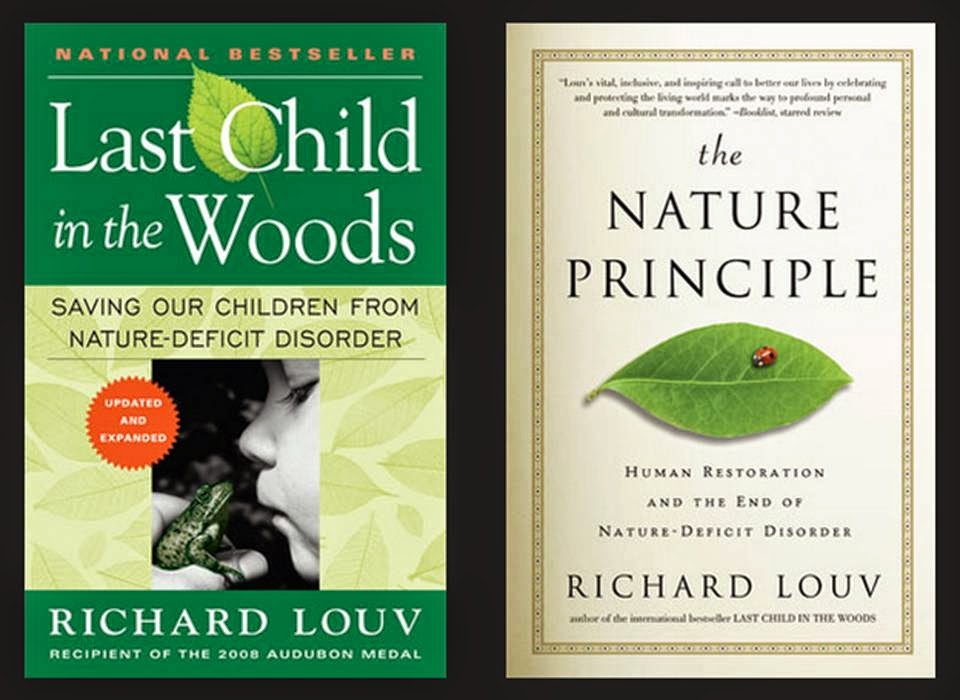
Mr. Sharper made his comments in reference to the work on Natured Deficit Disorder or NDD, pioneered by Richard Louv and featured in his books Last Child in the Woods: Saving our Children from Nature Deficit Disorder and The Nature Principle: Human Restoration and the End of Nature-Deficit Disorder.


Richard Louv is not only a journalist and author of eight books about the connections between traditionally recognized human institutions of family and community with nature. He received the Audubon Medal in 2008 and the Cox Award in 2007. In his newest book, The Nature Principle, Louv offers readers:

“a new vision of the future, in which our lives are as immersed in nature as they are in technology. This future, available to all of us right now, offers better psychological, physical and spiritual health for people of every age.” 
Source: richardlouv.com: About Richard Louv

What does PeapodLife think about all this? It’s quite simple, really: nature represents the gateway to a whole other kind of “network,” one which the Internet can scarcely hold a candle to…an UNLIMITED SOURCE of KNOWLEDGE; an INFINITE WEALTH of BEAUTY, INSPIRATION, IMAGINATION and PEACE.

Our previous blog article, Nature’s Perfection Recorded Beautifully: Birds on The Wires is Music to Our Ears attempted to illustrate how nature has in the past inspired geniuses throughout time and in every area of human endeavour—and continues to  do so. “But for how long?” is the question we posed.

And we pose it again: how long will nature serve humanity as a gateway to “the cosmic web” if our last bastions of pure, unadulterated natural splendour become infected by the mechanical, technocratic paradigm?

What marvels of inspiration, what deep, world-changing insights will be lost to another level of Angry Birds or Candy Crush Saga?  What precious once-in-a-lifetime opportunities will be lost forever because the individuals “present” were more concerned about taking a selfie and posting it to Instagram than being truly present to witness the miracle of nature unfolding before them?

PeapodLife believes wholeheartedly in the work of Richard Louv and others, but we take it to a whole new level. It’s not enough to occasionally expose ourselves and our children to nature. We must learn to live in harmony and mutual symbiosis with nature again.

This means submerging ourselves into the energetic field which only ecosystems generate; surrounding ourselves in our daily lives with healing, calming, rejuvenating and inspiring energies. We know that by doing so, this question of Wi-Fi in national parks will simply go away. We won’t need it.

In fact, we may begin to find ourselves relying less on Wikipedia (and the like) and more on our own innate (but currently atrophied) abilities to access universal knowledge.

Image: There is no Wi-fi in the forest, but I promise you will find a better connection
Source: facebook.com: Echoes of the Heart Healing: Album:Mobile Uploads: Grateful for Higher Connections


Tuesday, 29 April 2014

Nature’s Perfection Recorded Beautifully:
Birds on The Wires is Music to Our Ears

VIDEO: Birds On The Wires - LIVE- [Official Version] (HD) TEDx São Paulo by Gabriel agnelli 
Source: YouTube: http://youtu.be/Rt5R0dZKIho


Every now and then we come across a story, photo or video online that just makes our day. This is one of them.

Posted yesterday on Huffington Post Arts & Culture section, the video by Jarbas Agnelli is testament to the beauty that’s possible when our own creative intuition—imagination, inspiration, whichever word speaks to you—conspires with that of nature itself to create a work of wonder.

The original photo of the birds on electric wires, taken by Paulo Pinto, was published in 2009 in the Brazilian Newspaper, "O Estado de São Paulo."

Agnelli recounts the episode:
"Reading the newspaper one morning, I saw this picture of birds on the electric wires…I cut out the photo and decided to make a song, using the exact location of the birds as notes. I was just curious to hear what melody the birds were creating…I just erased the birds for effect at the end, but didn't change their positions at all. What would be the point?"
~ Jarbas Agnelli

Agnelli isn’t the first musician to be inspired by nature, and we certainly hope he won’t be the last. Beethoven’s 5th Symphony, so it is said, was famously inspired by the ortolan bunting (E. hortulana).

VIDEO: Saving the songbird that inspired Beethoven by swissinfovideos 
Source: YouTube: http://youtu.be/9o8XD00tEfs


Both Agnelli and Beethoven stand in the company of countless painters, sculptors, writers, playwrights, designers, philosophers, theologians, scientists, and engineers of all stripes and disciplines, who saw something in nature (we use the term “to see” in the esoteric sense: felt, heard, sensed, et al).

What did they see? Beauty. Truth. Answers to their deepest questions and fulfillment of their most profound longings. This tradition continues, from art to biomimicry, but for how long?

As the Swiss TV video reports, the little bird that inspired one of the greatest pieces of music written, is at risk of extinction in Switzerland, though efforts are being made to preserve and revitalize its habitat.

What’s more, this humanity all too often sees not with the intuitive “third eye” of the heart, but rather the cold, heartless rational eyes of the head: missing the deeper Truths nature has to teach us in favour of superficial observations that support our highly intellectual, subjective and egoistic worldviews.

Case in point: a most troubling blog posted on HuffPost Green by Carl Pope, “Takers and Makers in the Rain Forest.”   Despite being the former Executive Director and Chairman of Sierra Club, Pope examines the relationship between Ficus, the so-called “strangler figs,” and other types of trees in the rainforest in capitalist terminology.

Image: The inside of Ficus auereus, “the strangler fig,” long after it’s host tree has perished.

And although his ultimate conclusion seems benign enough, (that it’s better if we do not behave like the strangler fig) his supposition is entirely flawed and subjective:
"The approach the strangler takes to success -- exploit the efforts of others, and value speed and aggression above everything else -- can, indeed, prove "competitive.""

Only a mind conditioned by humanity’s modus operendi of exploitation of nature sees exploitation within nature. Mr. Pope ignores the infinite complexity and intelligence of the high-order ecosystems in which Ficus and its “hosts” are born, live, sacrifice and die. Yes, sacrifice.

Until one listens to the stillness within one’s own heart, like Beethoven, Agnelli, and countless geniuses and masters of their craft did, one will not be inspired by nature to create works of Truth and beauty, worthy of posterity and the ages.

While one only remains in the cold prison of the intellect, subjective and conditioned by “the big machine” that humanity built, one will only produce intellectual drivel aligned with the status quo…just more uninspired baying by another uncreative sheep.

That said, the more one opens oneself to the ecosystem, to the deeper truth of nature: that mutual harmony and symbiosis are its modus operendi, the more one will have access to authentic inspiration, imagination, creative intuition, outside-the-box thinking, and all the faculties of awakening consciousness employed by all the great masters throughout history.

And that, dear friends, is an enterprise worth pursuing, singing about, or at the very least, humming along to…

VIDEO: Birds on the Wires by Jarbas Agnelli
Source: YouTube: http://youtu.be/LoM4ZZJ2UrM 
Original Photography by Paulo Pinto


Thursday, 10 April 2014

Would You Take Advice from This Man? A Country Did, and they Ended Apartheid
Desmond Tutu to the World: “We need an apartheid-style boycott to save the planet.”*

Image: Archbishop Desmond Tutu

“We must stop climate change.
And we can, if we use the tactics that worked in South Africa against the worst carbon emitters”

~ Desmond Tutu, The Guardian, 10 April 2014
With the death of Nelson Mandela, a nation saw their Father of Freedom pass into the annals of history. But Mandela was not alone in his struggle against apartheid. Desmond Tutu’s efforts emerged as a loud and steady voice against the forces of freedom and inequality. They worked.

Now, Desmond Tutu is at it again, only this time, he is turning his voice to the cause of ending climate change. And his opening salvo was directed squarely at Canada and the U.S. who is as we speak:

“debating whether to approve a massive pipeline transporting 830,000 barrels of the world's dirtiest oil from Canada to the Gulf of Mexico. Producing and transporting this quantity of oil, via the Keystone XL pipeline, could increase Canada's carbon emissions by over 30%.”*

And, as he did versus Apartheid, he is calling on the people of the world listen and take action. Whereas apartheid was, it could be argues, a regional struggle, the negative impacts of climate change “affect the whole world, our shared world, the only world we have.”*

Citing his believe in “the only just response to injustice,”* Mahatma Gandhi’s passive resistance, Tutu suggests using boycotts, divestment and sanctions, as in the anti-apartheid struggle in South Africa.

“It is clear that those countries and companies primarily responsible for emitting carbon and accelerating climate change are not simply going to give up; they stand to make too much money. They need a whole lot of gentle persuasion from the likes of us.”*

So what does an Apartheid-Style anti-climate change strategy look like?

“We cannot necessarily bankrupt the fossil fuel industry. But we can take steps to reduce its political clout, and hold those who rake in the profits accountable for cleaning up the mess.”*

Tutu believes serious economic and moral pressure is needed. “People of conscience need to break their ties with corporations financing the injustice of climate change.” *

Here are some anti-climate change tactics taken from the pages of Tutu’s anti-apartheid playbook:
  • Boycott the events, sports teams and media programming they sponsor and/or produce
  • Demand energy company advertisements come with health warnings
  • Encourage universities and municipalities to cut ties with these companies
  • Organize car-free days
  • Build social awareness
  • Ask religious leaders and their communities to take a stand
  • Encourage energy companies to invest more in the development of renewables
  • Reward companies who invest in new clean technologies by buying their products
  • Install solar panels (and other renewable energy sources) where possible
Tutu suggests all this because “It makes no sense to invest in companies that undermine our future.”*

On a bit of good news, the article suggests that “General Synod of the Church of England voted overwhelmingly to review its investment policy in respect of fossil fuel companies;” and, “colleges and pension funds have declared they want their investments to be congruent with their beliefs.”*

On another bit of good news, he suggests that young people are leading the charge on climate change and that “The fossil fuel divestment campaign is the fastest growing corporate campaign of its kind in history.”*

* From Desmond Tutu’s Editorial in The Guardian, Thursday 10 April 2014 17.00 BST;
Source: http://www.theguardian.com/commentisfree/2014/apr/10/divest-fossil-fuels-climate-change-keystone-xl

Thursday, 3 April 2014

Confessions of a Nature-Lover


Today we are trying something different.

We came across the above image on Facebook and thought we’d share it as part of a kind of social experiment to determine how many of us “nature lovers” harbour fears, phobias, et cetera toward members of the animal kingdom?

You can post your comments below or on our Facebook page.

And to help get you in the mood…


You get the idea… 

Tell us your nature confessions!

DISCLAIMER: PeapodLife Rainforest EcoSystems do not come with giant spiders, stinging insects, or poisonous snakes. We also avoid toxic plants and flowers.

Thursday, 20 February 2014

Touch the Web of Life, for
the Web of Life Touches us All

Image: Child touching the Web of Life

“Humankind has not woven the web of life. We are but one thread within it. Whatever we do to the web, we do to ourselves. All things are bound together. All things connect.”
~ Chief Seattle
Source: Goodreads: Book reviews, recommendations, and discussion: Chief Seattle  

It is irrefutable. We are all connected. And as much as we would like to think of ourselves “lords of nature,” the reality is we are not separate from it, from the planet that supports in; and indeed, the solar system—the sun—which in turn supports it.

We have no energy system to replace the sun. We have no technology whatsoever that comes close to replacing all that it does for the planet…and for us.

Likewise we rely on the systems of the planet: the water cycle; the carbon cycle; the countless ecosystems which interconnect to provide us the flora and fauna and moderate the planet’s climate.

Somehow, humanity has lost sight of all this.  Beginning largely in the industrial revolution, intensified in the technological revolution, we have become enthralled with all of our systems; everything we do for ourselves.

Sadly, so much of what we do for ourselves comes at the expense of the planet: masses of conventional, toxic and radiocactive waste; air, water and soil pollution; exploitation of finite natural resources; failure to responsibly manage renewable resources; and the list goes on.

We have lost our connection with the web of life; and, sadly, are at risk of becoming entangled in the web we have woven instead. A web of toxicity, scarcity, exploitation, detachment from the ecological realities which affect us all—industrialization or no; technologically advanced or not.

How can we reconnect with the web of life? Surely we cannot take on all the world’s problems! No one can shoulder the burden of environmental challenges which took generations to create. But can we turn the tide of exploitation and detachment from nature in our individual lives?

PeapodLife believes we can. We believe in indoor ecosystems. We believe in working, living, learning and healing in buildings which support nature in her highest expression: high-order rainforest ecosystems.

More than this, PeapodLife knows that when you live in the company of a rainforest ecosystem, you do much more than benefit materially from all it has to give. You reconnect with the essence of nature herself. You develop a meaningful relationship: one of mutual harmony and symbiosis.    

With PeapodLife, you become part of the web of life, once again. And being a part of the web of life is much better than being apart from it. Touching the web of life is better than weaving a web of destruction.

Take to heart the wise words of First Nations Elder Chief Seattle, who said:
“All things are connected.
Whatever befalls the earth
Befalls the sons of the earth.
Man did not weave the web of life,
He is merely a strand in it.
Whatever he does to the web,
He does to himself.”
~ Chief Seattle
Source: Goodreads: Book reviews, recommendations, and discussion: Chief Seattle  

Image: Chief Seattle, Chief of the Duwamish and Suquamish.
Photograph of drawing by artist Ray Coombs after the well-known photograph by E. M. Sammis


Touch the web of life; and let the web of life touch you.