Thursday, 15 May 2014

How to Recruit & Retain Top Talent, the Natural Way
Ecosystems give New Life to your Company’s Strategy to Attract & Keep Top Talent

Image: Dream Job Next Exit…PeapodLife  
Image Credit: skedx.com: Are You Successfully Retaining Top Talent?
“A frustrated employee is a greater threat than a merely unhappy one.”
~ Bill Hewlett and David Packard, Founders of HP
Source: logomaker.com: 11 Inspirational Quotes from Bill Hewlett and David Packard

Conventional wisdom among researchers is “that the best way to hire and keep top talent is to create a company culture where the best employees want to work, a culture in which people are treated with respect and consideration at all times.” (Source: entrepreneur.com: Entrepreneur: How to Recruit Top Talent)

As far as PeapodLife is concerned, this is not a goal in and of itself. A company treating people with respect and consideration at all times should be the starting point of any endeavour, and not the “best practice employee recruitment and retention strategy.”

(For the record, we actually wince at the whole “recruitment and retention strategy” terminology, along with the idea of a fabricated “culture,” but we’ll go along with it for now.)

Of course, there are companies who no-doubt would agree with us. Enter Google, with its foosball tables, rock-climbing walls, video game consoles and countless other toys, gimmicks, and other distractions appealing to their young, hip, geeky employee demographics who want their time spent on Google’s “campuses” to be just that: an extension of university life.

We cannot, of course, testify to what it’s actually like working at Google: we don’t know if respect and consideration at all times there, we like to assume it is; but as for the “above and beyond the call of duty,” the bobbles, bells, whistles and do-dads of romper-room for IT professionals strikes us as trying too hard to be hip, and not exactly natural (they are, after all, supposed to be adults).

What we would suggest to any company—large or small—is to start by getting an ecosystem. Simple. So what will it do to your ability to attract and keep the best employees? It will create an environment in which they will want to spend their time and that will help them thrive.

It doesn’t have to be huge:


It doesn’t need to make a huge statement, although it can do:

Image by PeapodLife: Living Wall Ecosystem at Tel-E-Connect Ontario

Top talent want to perform. We are products of our environment. Yes, of course, a positive, kind, caring, nurturing culture is important, but guess what: unless the environment is supportive of such a culture, it’s fighting an up-hill battle to survive, let alone thrive.

Just think of it: all the respect and consideration in the world can’t do anything to mitigate poor air quality, sick building syndrome, and the stresses that top-performers often subject themselves to. A high-order rainforest ecosystem from PeapodLife can do something about it, and so much more.

Just how much more? Legend has it that upon entering the former head offices of Club Monaco and walking through its indoor ecosystem (which included a lagoon and two 40-foot living walls), Ralph Lauren decided to buy the Company. That’s the kind of deep-felt impact your company can have on an individual, whether they are a prospective partner, client, and yes, manager or employee.

Don’t take our word for it. You know yourself how quickly you feel at home in a space (or not); we have an innate, natural ability to sense belonging.

On top of all that, the positive impact the fresh, clean air and vibrant rainforest colours will have on your entire organization will help revitalize energy, imagination and inspiration while reducing stress, anxiety and conflict. All that will go a long way towards the baseline goal of respect and consideration at all times.

We are products of our environment. So is your culture, and all your talent. Keep that in mind, and contact us to experience the power of PeapodLife for yourself.

Image by PeapodLife: Office-Space transformed into an environment for top-performance by top-talent


Thursday, 8 May 2014

Shinrin Yoku the Ecosystem way:
Get the Health Benefits of Nature Exposure 24/7, 365 days of the year


“I only went out for a walk and finally concluded to stay out till sundown, for going out, I found, was really going in.”
— John Muir, “John of the Mountains: The Unpublished Journals of John Muir”; Edited by Linnie Marsh Wolfe (University of Wisconsin Press, 1938, republished 1979)*

Dozens of scientific studies, mostly conducted in Japan, have returned hard evidence to suggest that spending time in greenspace is good for your physical and mental health. The practice known as Shinrin Yoku or “forest bathing” reduces cortisol levels and also seems to boost immune system.


Although scientists attribute the psychological, physiological and immunological benefits of forest bathing to breathing in volatile substances, called phytoncides (wood essential oils), which are antimicrobial volatile organic compounds derived from trees, such as a-pinene and limonene, (Source: http://en.wikipedia.org/wiki/Forest_bathing) PeapodLife has an alternative explanation.
“There is a pleasure in the pathless woods,
There is a rapture on the lonely shore,
There is society, where none intrudes,
By the deep sea, and music in its roar:
I love not man the less, but Nature more.”
— George Gordon, Lord Byron, “Childe Harold’s Pilgrimage”*

The connection between Shinrin-yoku and aromatherapy is not without merit, but here again, a materialist scientific approach to both erroneously assumes that it is exposure to the physical substances compounds themselves which confers benefits.

In many traditions of herbal and esoteric medicine, oils must be activated through the application of heat; incense, for example, must be burned—more accurately expressed and effectively activated as smoldered. In other words, there is an energetic quality at work play.

It is this energy, the stress-relieving, life-giving, immune-system-boosting and mood enhancing power of nature that emanates from all natural environments; but particularly from ecosystems. The higher-order the ecosystem, the greater the benefits—physical and psychological.

Unfortunately, until materialist science is trapped within the confines of lower-order intelligence, it will not likely accept nor endorse either the high-order intelligentsia of ecosystems or their high-order energetic benefits, shackled as they are to the paradigm of “physical evidence.” Perhaps said scientists have spent too much time studying nature in cold, heartless laboratories…
“Man’s heart away from nature becomes hard.”
— Standing Bear*

One thing is certain: it takes only a moment or two in the company of a PeapodLife ecosystem to feel said energy and know something intelligent is working to make you feel better…it’s a knowing you feel in your heart.

*All Quotes Sourced from: nscblog.com: Nathan S. Collier BLOG: Shinrin-yoku

Thursday, 1 May 2014

Is WiFi in Canadian National Parks the Future of Nature Appreciation or just a Digital Distraction?

Video: Parks Canada wants to install wireless internet access hotspots at up to 50 of its parks this year

"My thoughts can be expressed quite simply. I think it is a disastrous, quite stupid, idiotic concept, and should be eliminated immediately."
~ Farley Mowat, author, environmentalist, activist, one of Canada's most widely read authors

"I think the idea of WiFi in the national parks is great…if you don't want to partake just don't bring your phone. It might even get people out to the parks who otherwise wouldn't go.... they'll probably hopefully get distracted by all that nature."
~ Kathy Daley, camping enthusiast from Winnipeg
Source: cbc.ca: CBC Radio The Current with Anna Maria Tremonti: WiFi in some of Canada's national parks gets a fuzzy reception from campers

It’s a fair question, is it not? Quite a divisive question in fact: one which seems to be causing quite the stir not just in certain circles, but among the general public. Is Wi-Fi in Canadian national parks the future of nature appreciation or just a digital distraction?

The point—that we are living in a digital age and that internet access might make national parks more palatable to a new generation of young, wired Canadians—on the surface has its merits. Why not entice young people away from their cloistered computer screens to experience the great outdoors?

The counterpoint was summarized well by Stephen Sharper, columnist for The Toronto Star and an associate professor of the School for The Environment at the University of Toronto in a panel discussion on CBC Radio’s The Current with Anna Maria Tremonti:
“Children who often suffer from ADHD, from suicidal tendencies, and depression often improve dramatically when exposed to nature. And it doesn’t have to be a wilderness experience, it can be a visitors’ centre at a national park. But it’s direct experience with nature, not mediated through computers or Wi-Fi technology…[which] is very salutary and very important for the psychology and physical wellbeing of our children. And anything that can enhance that and foster that, I think, is to be promoted.”
~ Stephen Sharper, School for The Environment at the University of Toronto
Source: CBC Radio’s The Current with Anna Maria Tremonti

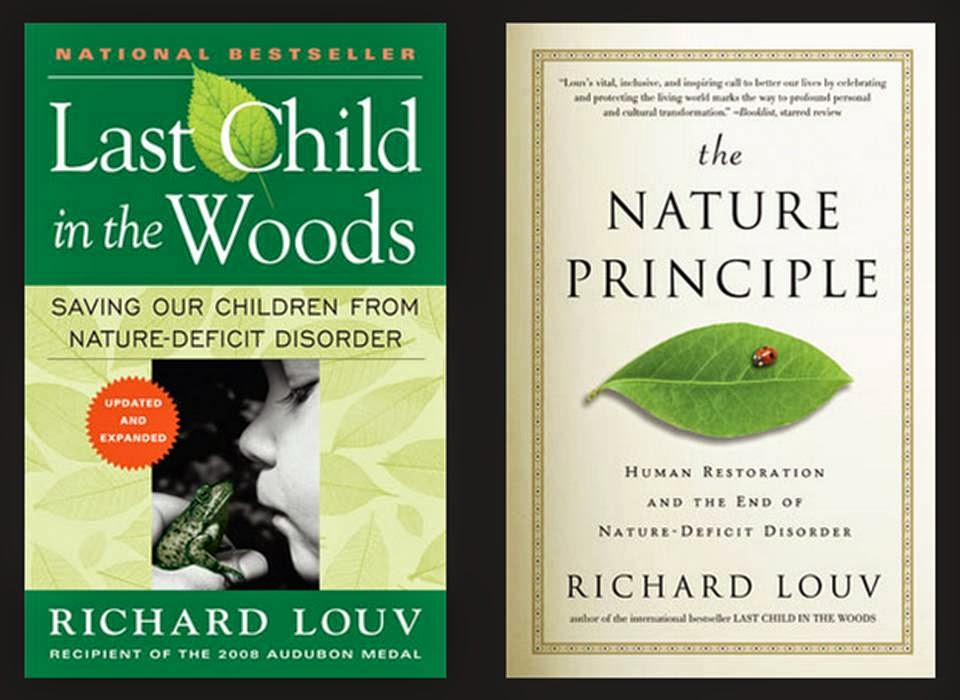
Mr. Sharper made his comments in reference to the work on Natured Deficit Disorder or NDD, pioneered by Richard Louv and featured in his books Last Child in the Woods: Saving our Children from Nature Deficit Disorder and The Nature Principle: Human Restoration and the End of Nature-Deficit Disorder.


Richard Louv is not only a journalist and author of eight books about the connections between traditionally recognized human institutions of family and community with nature. He received the Audubon Medal in 2008 and the Cox Award in 2007. In his newest book, The Nature Principle, Louv offers readers:

“a new vision of the future, in which our lives are as immersed in nature as they are in technology. This future, available to all of us right now, offers better psychological, physical and spiritual health for people of every age.” 
Source: richardlouv.com: About Richard Louv

What does PeapodLife think about all this? It’s quite simple, really: nature represents the gateway to a whole other kind of “network,” one which the Internet can scarcely hold a candle to…an UNLIMITED SOURCE of KNOWLEDGE; an INFINITE WEALTH of BEAUTY, INSPIRATION, IMAGINATION and PEACE.

Our previous blog article, Nature’s Perfection Recorded Beautifully: Birds on The Wires is Music to Our Ears attempted to illustrate how nature has in the past inspired geniuses throughout time and in every area of human endeavour—and continues to  do so. “But for how long?” is the question we posed.

And we pose it again: how long will nature serve humanity as a gateway to “the cosmic web” if our last bastions of pure, unadulterated natural splendour become infected by the mechanical, technocratic paradigm?

What marvels of inspiration, what deep, world-changing insights will be lost to another level of Angry Birds or Candy Crush Saga?  What precious once-in-a-lifetime opportunities will be lost forever because the individuals “present” were more concerned about taking a selfie and posting it to Instagram than being truly present to witness the miracle of nature unfolding before them?

PeapodLife believes wholeheartedly in the work of Richard Louv and others, but we take it to a whole new level. It’s not enough to occasionally expose ourselves and our children to nature. We must learn to live in harmony and mutual symbiosis with nature again.

This means submerging ourselves into the energetic field which only ecosystems generate; surrounding ourselves in our daily lives with healing, calming, rejuvenating and inspiring energies. We know that by doing so, this question of Wi-Fi in national parks will simply go away. We won’t need it.

In fact, we may begin to find ourselves relying less on Wikipedia (and the like) and more on our own innate (but currently atrophied) abilities to access universal knowledge.

Image: There is no Wi-fi in the forest, but I promise you will find a better connection
Source: facebook.com: Echoes of the Heart Healing: Album:Mobile Uploads: Grateful for Higher Connections


Tuesday, 29 April 2014

Nature’s Perfection Recorded Beautifully:
Birds on The Wires is Music to Our Ears

VIDEO: Birds On The Wires - LIVE- [Official Version] (HD) TEDx São Paulo by Gabriel agnelli 
Source: YouTube: http://youtu.be/Rt5R0dZKIho


Every now and then we come across a story, photo or video online that just makes our day. This is one of them.

Posted yesterday on Huffington Post Arts & Culture section, the video by Jarbas Agnelli is testament to the beauty that’s possible when our own creative intuition—imagination, inspiration, whichever word speaks to you—conspires with that of nature itself to create a work of wonder.

The original photo of the birds on electric wires, taken by Paulo Pinto, was published in 2009 in the Brazilian Newspaper, "O Estado de São Paulo."

Agnelli recounts the episode:
"Reading the newspaper one morning, I saw this picture of birds on the electric wires…I cut out the photo and decided to make a song, using the exact location of the birds as notes. I was just curious to hear what melody the birds were creating…I just erased the birds for effect at the end, but didn't change their positions at all. What would be the point?"
~ Jarbas Agnelli

Agnelli isn’t the first musician to be inspired by nature, and we certainly hope he won’t be the last. Beethoven’s 5th Symphony, so it is said, was famously inspired by the ortolan bunting (E. hortulana).

VIDEO: Saving the songbird that inspired Beethoven by swissinfovideos 
Source: YouTube: http://youtu.be/9o8XD00tEfs


Both Agnelli and Beethoven stand in the company of countless painters, sculptors, writers, playwrights, designers, philosophers, theologians, scientists, and engineers of all stripes and disciplines, who saw something in nature (we use the term “to see” in the esoteric sense: felt, heard, sensed, et al).

What did they see? Beauty. Truth. Answers to their deepest questions and fulfillment of their most profound longings. This tradition continues, from art to biomimicry, but for how long?

As the Swiss TV video reports, the little bird that inspired one of the greatest pieces of music written, is at risk of extinction in Switzerland, though efforts are being made to preserve and revitalize its habitat.

What’s more, this humanity all too often sees not with the intuitive “third eye” of the heart, but rather the cold, heartless rational eyes of the head: missing the deeper Truths nature has to teach us in favour of superficial observations that support our highly intellectual, subjective and egoistic worldviews.

Case in point: a most troubling blog posted on HuffPost Green by Carl Pope, “Takers and Makers in the Rain Forest.”   Despite being the former Executive Director and Chairman of Sierra Club, Pope examines the relationship between Ficus, the so-called “strangler figs,” and other types of trees in the rainforest in capitalist terminology.

Image: The inside of Ficus auereus, “the strangler fig,” long after it’s host tree has perished.

And although his ultimate conclusion seems benign enough, (that it’s better if we do not behave like the strangler fig) his supposition is entirely flawed and subjective:
"The approach the strangler takes to success -- exploit the efforts of others, and value speed and aggression above everything else -- can, indeed, prove "competitive.""

Only a mind conditioned by humanity’s modus operendi of exploitation of nature sees exploitation within nature. Mr. Pope ignores the infinite complexity and intelligence of the high-order ecosystems in which Ficus and its “hosts” are born, live, sacrifice and die. Yes, sacrifice.

Until one listens to the stillness within one’s own heart, like Beethoven, Agnelli, and countless geniuses and masters of their craft did, one will not be inspired by nature to create works of Truth and beauty, worthy of posterity and the ages.

While one only remains in the cold prison of the intellect, subjective and conditioned by “the big machine” that humanity built, one will only produce intellectual drivel aligned with the status quo…just more uninspired baying by another uncreative sheep.

That said, the more one opens oneself to the ecosystem, to the deeper truth of nature: that mutual harmony and symbiosis are its modus operendi, the more one will have access to authentic inspiration, imagination, creative intuition, outside-the-box thinking, and all the faculties of awakening consciousness employed by all the great masters throughout history.

And that, dear friends, is an enterprise worth pursuing, singing about, or at the very least, humming along to…

VIDEO: Birds on the Wires by Jarbas Agnelli
Source: YouTube: http://youtu.be/LoM4ZZJ2UrM 
Original Photography by Paulo Pinto


Tuesday, 15 April 2014

It’s Quality of Life, NOT Quantity of Life:
Downsize Your Upscale Lifestyle to a Life of Substance (with plenty of Style)

Image by PeapodLife: Your Quality of Life wants its Perspective Back.   
Mansion Images Source: mansionproject.blogspot.ca: The Mansion Project - Bridle Path, Toronto, Canada - Part 2
“Giving up a home we were so proud of, I was expecting more condolences for the death of my upper middle class lifestyle, but friends wondered if they could get rid of all the clutter that bogged them down too. I was feeling shame for sure... but little by little, after three garage sales and a few trips to Goodwill I realized that material goods are not my identity. Making a massive difference in the world and keeping my family intact, much higher calling.”
~ Julie Kantor
Source: huffingtonpost.com: Huffington Post: Home: Julie Kantor: 5 Things I've Learned From Downsizing Our Lives -- Part 1

We’re not the first to talk about downsizing your lifestyle, and we certainly won’t be the last. From The Huffington Post series by Julie Kantor to an article on Scaling down a retirement lifestyle by Sonya Stinson on Bankrate.com, many smarter and more eloquent individuals have expounded on the many virtues of downscaling your lifestyle.

And while Julie and her family moved into a rental apartment, we at PeapodLife don’t necessarily believe one has to take such drastic steps to achieve the same goal. On the contrary, we have what we believe to be a unique take on the whole downsizing your upscale lifestyle to a LIFE OF SUBSTANCE.

If you’re living in the Greater Toronto Area, chances are your upper-middle-class home is worth in excess of a million dollars, and likely several million. The real estate market is very hot in Toronto these days, and there may never be a better opportunity to “sell high.”

But let’s say you do sell? You still have to buy another home. How will it be different? Also, what will you do with the excess cash? Where will you invest it? So long as you’ve lived in your home a number of years there’s no capital gains, but there are important financial considerations to make.

What if you could live in a green dream home and build 9 more like it for others to live in? You could sell them, rent them, or let PeapodLife’s Property Management Partners manage them for you.

You’re still invested in Real Estate, but no longer tied to a single enormous house you don’t need. Instead, you’ve diversified your real estate investment and are helping lower- and middle-income families also live in healthy green dream homes with PeapodLife ecosystems.

So, let’s be practical and walk through PeapodLife’s process step-by-step complete with some numbers. To keep it simple, we’ll work with a net house value of $2.5 million (after all real estate commissions and fees and any mortgage balance outstanding on the property; this is a fair number in today’s Toronto market for an upper-middle-class home).

   •    House worth $2.5 million (cash on hand after sale)
   1.    Get pre-approved for 10 mortgages of roughly $1 million each ($10 million total).
   2.    PeapodLife’s Affiliated Realtors locate 10 “sub par” properties (fixer-uppers) with one in a desirable neighbourhood you wish to live. All 10 (or just 9) can be selected on the basis of being able to be turned into duplexes with legal 2nd Suite Basement Apartments (income properties). Conditional offers are made on the properties.
   3.    PeapodLife’s Affiliated Architectural Technologists Inspect Homes, plans changes, prices out improvements including cost of high-order rainforest ecosystems on all 10 properties. Each property, cost of home + green renovations including ecosystem comes to less than $1 million.
   4.    Close on homes; roughly $250K downpayment on each ($2.5 million total, or cash on hand after sale of upscale home).
   5.    PeapodLife Affiliated Performance-bonded Contractors do the renovations & PeapodLife installs ecosystems.
   •    You are now the proud owner of 10 sensibly designed Green Dream Homes, 9 of which are income properties, all of which feature the healthiest, most vibrant, beautiful and stress-free living environment imaginable: PeapodLife BEST HOMES…Building EcoSystems & Technology via Home Ownership for the Masses that’s Economical & Social.
   •    You can rent, sell, or gift to your children any of the 10 BEST HOMES…whatever you choose. But make no mistake: you’re the hero here: you’ve transformed 10 run-down old houses into 10 green dream duplexes, all with legal basement apartment dwellings unlike anything else in the GTA.

So long as you can carry the mortgages, you can wait for bidding wars to break out on any of the properties (which is not unheard of in today’s market). In the meantime, you can hand over the Property Management to PeapodLife’s Real Estate Partner and either earn an income (or at least carry the mortgage).

Or, if you want a real life of substance, you can price the homes fairly (which still gives you an R.O.I. of $125K per house, or 50% ROI) and give 18 families (9 x residences) access to affordable green dream homes, knowing you’ve helped rejuvenate aging buildings in Toronto, and progressed the Green Building Movement.

PeapodLife’s BEST HOMES: Green Dream Homes in 5 Easy Steps 

No matter how you look at it, it’s a win-win-win. No matter how you slice it, you’ve downsized into a life of REAL SUBSTANCE, with the healthiest, stress-free living space for you, and for 18 other families in your community.

Email us today to get started: info@peapodlife.com.


Thursday, 10 April 2014

Would You Take Advice from This Man? A Country Did, and they Ended Apartheid
Desmond Tutu to the World: “We need an apartheid-style boycott to save the planet.”*

Image: Archbishop Desmond Tutu

“We must stop climate change.
And we can, if we use the tactics that worked in South Africa against the worst carbon emitters”

~ Desmond Tutu, The Guardian, 10 April 2014
With the death of Nelson Mandela, a nation saw their Father of Freedom pass into the annals of history. But Mandela was not alone in his struggle against apartheid. Desmond Tutu’s efforts emerged as a loud and steady voice against the forces of freedom and inequality. They worked.

Now, Desmond Tutu is at it again, only this time, he is turning his voice to the cause of ending climate change. And his opening salvo was directed squarely at Canada and the U.S. who is as we speak:

“debating whether to approve a massive pipeline transporting 830,000 barrels of the world's dirtiest oil from Canada to the Gulf of Mexico. Producing and transporting this quantity of oil, via the Keystone XL pipeline, could increase Canada's carbon emissions by over 30%.”*

And, as he did versus Apartheid, he is calling on the people of the world listen and take action. Whereas apartheid was, it could be argues, a regional struggle, the negative impacts of climate change “affect the whole world, our shared world, the only world we have.”*

Citing his believe in “the only just response to injustice,”* Mahatma Gandhi’s passive resistance, Tutu suggests using boycotts, divestment and sanctions, as in the anti-apartheid struggle in South Africa.

“It is clear that those countries and companies primarily responsible for emitting carbon and accelerating climate change are not simply going to give up; they stand to make too much money. They need a whole lot of gentle persuasion from the likes of us.”*

So what does an Apartheid-Style anti-climate change strategy look like?

“We cannot necessarily bankrupt the fossil fuel industry. But we can take steps to reduce its political clout, and hold those who rake in the profits accountable for cleaning up the mess.”*

Tutu believes serious economic and moral pressure is needed. “People of conscience need to break their ties with corporations financing the injustice of climate change.” *

Here are some anti-climate change tactics taken from the pages of Tutu’s anti-apartheid playbook:
  • Boycott the events, sports teams and media programming they sponsor and/or produce
  • Demand energy company advertisements come with health warnings
  • Encourage universities and municipalities to cut ties with these companies
  • Organize car-free days
  • Build social awareness
  • Ask religious leaders and their communities to take a stand
  • Encourage energy companies to invest more in the development of renewables
  • Reward companies who invest in new clean technologies by buying their products
  • Install solar panels (and other renewable energy sources) where possible
Tutu suggests all this because “It makes no sense to invest in companies that undermine our future.”*

On a bit of good news, the article suggests that “General Synod of the Church of England voted overwhelmingly to review its investment policy in respect of fossil fuel companies;” and, “colleges and pension funds have declared they want their investments to be congruent with their beliefs.”*

On another bit of good news, he suggests that young people are leading the charge on climate change and that “The fossil fuel divestment campaign is the fastest growing corporate campaign of its kind in history.”*

* From Desmond Tutu’s Editorial in The Guardian, Thursday 10 April 2014 17.00 BST;
Source: http://www.theguardian.com/commentisfree/2014/apr/10/divest-fossil-fuels-climate-change-keystone-xl

Thursday, 3 April 2014

Confessions of a Nature-Lover


Today we are trying something different.

We came across the above image on Facebook and thought we’d share it as part of a kind of social experiment to determine how many of us “nature lovers” harbour fears, phobias, et cetera toward members of the animal kingdom?

You can post your comments below or on our Facebook page.

And to help get you in the mood…


You get the idea… 

Tell us your nature confessions!

DISCLAIMER: PeapodLife Rainforest EcoSystems do not come with giant spiders, stinging insects, or poisonous snakes. We also avoid toxic plants and flowers.