Showing posts with label stress. Show all posts

Tuesday, 7 April 2015

Bring the Mind Home at Last
with an Ecosystem in the Home First

“All of man’s difficulties arise from his inability to sit quietly in a room by himself.” We do so many things, we speak volumes, and we think an endless amount of useless thoughts, but we’ve lost the sense of being. We’ve lost our ground. The most important thing is presence. Being. We’re often so distracted that: “We’re scattered everywhere, but nobody is at home.”
~ Blaise Pascal, with Sogyal Rinpoche
Source: School of the Holy Science Facebook Page:

The French philosopher Pascal once said, “All of man’s difficulties arise from his inability to sit quietly in a room by...
Posted by School Of The Holy Science on Tuesday, April 7, 2015


Let’s face it: very few of us can sit quietly in a room by ourselves. For so many reasons, both internal and external, we find it very difficult to just be still with ourselves.

Whether it’s the cacophony of our crazy busy mind, our crazy buy life, or the mixed-mash-up of real and perceived distractions pulling our attention in all directions, we find ourselves living in a kind of hurricane; a typhoon of never-ending thoughts, worries, wants, to-do lists, etc.

Like a song that gets stuck in our head, we cannot escape the prison of “mental calm depravation.” We may even have difficulty sleeping; either unable to fall asleep due to the never-ending stream of thoughts troubling us and keeping us awake, or disturbing and unsettling dreams reflective of our waking psychological state.

And while it’s all well and good to tell ourselves we can “leave our troubles at the door,” the reality is our subconscious minds have other plans. Without taking time on a regular basis to relax, concentrate, visualize and remember, revere and experience our naturally pure state of being, we remain trapped on the hamster wheel of an unsettled mind; lost in the hurricane of our lives.

PeapodLife can help. High order ecosystems are the eye in the storm of our lives. An ecosystem in the home creates a space which encourages us to sit comfortably and quietly. The natural harmonics of the ecosystem coupled to the phenomenon of entrainment tune our senses, our central nervous system, and our brain to a more soothing state.

Add to this field of harmony and mutual symbiosis the beautiful colours, soothing sounds, replenishing oxygen, and ambiance of energy and vitality, and you experience a space where you have a chance to actually be…not only alone with yourself, but with whatever deeper experiences of reality your heart and mind are open to having, via meditation, a good book, just your own thoughts coming into clarity, or maybe just the deepest, soundest sleep you’ve had in ages.

The point is, we all can use an eye in the storm; a sanctuary and a place where positive rejuvenating harmonics help you return to your natural, optimal state of being. What you do when you arrive there is up to you. PeapodLife’s job is helping you get there…bringing an ecosystem into your home first so you can bring your mind home at last.
 
Our ‘Crazy-Busy’ Life is a Hurricane & PeapodLife is the Eye of the Storm
Image by PeapodLife: Our ‘Crazy-Busy’ Life is a Hurricane & PeapodLife is the Eye of the Storm


Thursday, 2 April 2015

A Shield Against 'Bad Vibes' in the Workplace:
Biomusicology, Lexicology, Entrainment, Ecosystems and YOU

“Discussion is an exchange of knowledge;
an argument an exchange of ignorance.”
~ Robert Quillen
Source: Brainy Quote: Argument Quotes

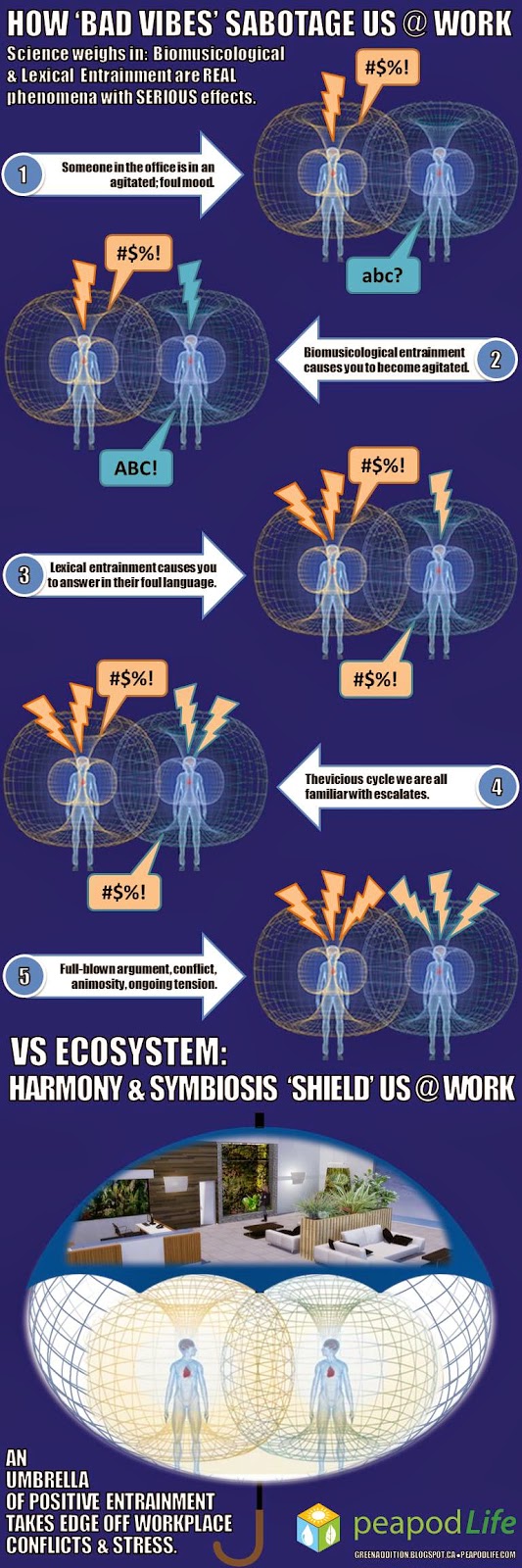
Infographic by PeapodLife: Negative Biomusicalogical & Lexical Entrainment VS. Ecosystem Harmonic & Symbiotic Entrainment at Work

We’ve all been there: the slippery slope and the downward spiral of the escalating argument. Be it at home or in the workplace, we all know the way things can get out of hand and tend to run away from us. Frustration, reactions, anger, aggression, things are said and done and…it rarely turns out well.

What we may not realize is there are real scientific phenomena affecting us during such conflicts. The fundamental principle involved is entrainment. In a general sense, entrainment is the tendency of oscillations or vibrations to synchronize.

Biomusicological entrainment is the phenomenon of entrainment applied specifically to biological organisms, including animals, human beings and ecosystems.  Biomusicalogical entrainment is responsible for everything from groupthink to mob mentality. 

Video: Bystander Revolution: Sam Trammell | Mob Mentality 

And make no mistake; everything the above video talks about applies to adults and adult group dynamics as much as it does for children, adolescents, etc. Why? Because age has nothing to do with the effects of biomusicalogical entrainment.

Lexical entrainment refers to the phenomenon whereby individuals tend to take on characteristics of speech from others in social situations—including intonation, vocabulary, etc.

Some are more sensitive to entrainment than others, but combined, biomusicalogical and lexical entrainment have a very real impact on our relationships and on our effective use of time and energy in the workplace.

Now, compound the effects of these two types of entrainment with the toxic sick buildings and lifeless environments we typically work in—from electromagnetic radiation from office equipment to noise stress, VOC’s and other sources of indoor atmospheric pollution, the list goes on.

There’s much more than just air quality to consider.  And sorry, Google, no amount of board games, beanbag chairs, foosball tables, or other manmade gimmicks can heal what is fundamentally a toxic environment, hostile to the optimum performance of living organisms…including us.

Enter PeapodLife Building EcoSystems & Technology

High order rainforest ecosystems are the BEST solution for countering the effects of negative biomusicalogical and lexical entrainment. The ecosystem acts as an umbrella, enveloping everyone in the space with a biomusicalogical entrainment field of harmony and symbiosis. Every organism—and person—within the field is constantly being entrained biomusicalogically by the infinitely complex interrelationships and balancing efforts of the superorganism in order to maximize  health, wellness and optimal function of each and every individual in said field.   

Image Rendering by PeapodLife: Imagine your office or workplace transformed into an atmosphere of optimal human performance, harmonic and symbiotic relationships, and health & wellness.
Now, are we saying an ecosystem will completely prevent all interpersonal conflict? Certainly not. But what it can do is take the edge off such conflicts. With the over-arching influence of the ecosystem—complete with beautiful orchids, bromeliads, soothing moss, flowing water, meditative fish, ionized living water counteracting the effects of harsh electromagnetic radiation, etc.—some conflicts might be shorter, or less intense, or more quickly resolved.

In the human body, melatonin is the hormone which is involved in the entrainment of the circadian rhythms of physiological functions including sleep timing and high blood pressure. Source: http://en.wikipedia.org/wiki/Melatonin Put another way, melatonin is the “calming hormone” in the body which counteracts the forces in us which lead to nervousness, agitation, stress, frustration, anger, etc. 

Think of a PeapodLife ecosystem as constantly washing your office space in a melatonin bath. But, unlike melatonin—which can have the effect of causing drowsiness—ecosystems stimulate the senses and invigorate our energy. In addition, nature boosts the immune system, improves mental faculties, increases inspiration and imagination, and all in all makes people feel better.

Imagine fewer sick days…fewer incidents of employees waking up thinking “ugh…I don’t feel like going into work,” when work is such a pleasant place to be.

How pleasant? Videos can’t do it justice, but here’s one anyway…

Video: PeapodLife Living Wall EcoSystem Fitch Street 

Now, just imagine what how all this will make you and your team FEEL? Imagine how much more you and your team will get done, and how much more pleasant an experience you’ll have doing it in the BEST indoor environment possible.  PeapodLife Building Ecosystems & Technology—be at your BEST.

Thursday, 26 March 2015

Jeremy Clarkson Sacked: Top Gear Fiasco
May Reveal the Tragedy of Chronic Stress

Collage by PeapodLife: Top Gear with Chronic Stress vs. EcoSystems
"I've always been a fan of his work on Top Gear…"It is with regret we will not be renewing Jeremy's contract."
~ Tony Hall, the Director General of the BBC
With these words, Director General of the BBC, Tony Hall, nailed the lid in the coffin of Jeremy Clarkson’s future hosting the wildly successful Top Gear. The dismissal relates to an alleged altercation between Clarkson and one of the show’s producers, involving a 30-second tirade and physical assault.

An investigation revealed, according to the official statement by the BBC, that the much loved presenter had “crossed a line.” Here is the official statement most fans of the show and casual onlookers alike have likely seen by now:


Video: 'Why sack your biggest global star?' Clarkson row:

All in all, it is safe to say that the entire incident and its predictable outcome have left all concerned with a bitter taste in their mouth.

Image: Jeremy Clarkson Meme – That’s not gone well 

Feelings of bitterness and regret were immediately expressed by fans of the show; not just online—as one might expect—but in person, via a 1-million signature petition, delivered to BBC headquarters in a dramatic fashion in keeping with the spirit and substance of the show itself.

Video: ‘The Stig’ delivers Jeremy Clarkson petition – BBC News 

Cynics and critics of Clarkson’s blokeish antics might argue that the stunt by fans is exactly the kind of aggressive over-reaction which caused the incident in the first place—and not the first time Clarkson got himself into hot water with BBC brass, either.

But we at PeapodLife couldn’t shake the feeling that there’s more going on here this time ‘round. And by all means while this is just speculation on our part, given the nature of this incident versus others the embattled host has been involved in, there was almost certainly something more insidious at work.

And, in the typical way society and the media avoid the topic due to the social stigma around mental health, no one seems to really be asking an important question…

Was Chronic Stress at least Partly to Blame for now Infamous Top Gear Fiasco?

Certainly, while on the surface this seems to be a case of a much beloved television presenter “losing it” in a fit of rage with a co-worker, a little research seems to suggest there’s more to the story than that.

According to fellow TV host Piers Morgan, “just like pretty much every other 50-something in life; angst-ridden from damaged relationships, grieving loved ones, irritated by work-related issues, and battling inner demons.” Source: https://reputationrefinery.com/jeremy_clarkson

Now certainly, this is no excuse for bad behaviour—especially violent behaviour—but there seem to be more mitigating circumstances coming to light.

BBC’s Creative Director Ala Yentob said BBC’s decision to extend the series to 12 shows may have been a mistake. "Whether it would have led to these events is speculative. It's very difficult to say why this happened. Clearly, workload is one thing, the stress of the year, all the rest of it." Source: http://www.independent.co.uk/arts-entertainment/tv/news/alan-yentob-refuses-to-rule-out-jeremy-clarkson-return-to-bbc-10134860.html

It turns out Clarkson had been dealing with a plethora of personal problems for some time, including a death in the family and a failing marriage. In other words, whatever triggered Clarkson to “cross the line” in professional conduct instead of on the track, was maybe just the straw that broke the camel’s back. Maybe he had been dealing with chronic stress, a condition which among the obvious rage and depression, can lead to all kinds of very real physical problems:

Image: Chronic Stress symptoms

Now, you can probably tell where we’re heading with this. The fact remains that the soothing, stress-reducing, and healing power of nature—especially ecosystems—can be a powerful “ecotherapy” tool in preventative mental and physical healthcare, including the management of chronic stress.

In many ways, then, we head right back into the discussion from Tuesday March 2015: Nature ‘Significantly’ Helps overcoming Disease: PhD Study.

The highlight?

Image: Clinical Studies prove nature sounds reduce stress and activate healing – Dr. Joe Dispenza
Image Credit: Rawforbeauty.com 

Are we saying an ecosystem in Jeremy Clarkson’s home, the Top Gear studio, and/or the pub where the altercation took place could have prevented the incident? Not directly, no.

What we are saying is that if chronic stress and pent up frustration and looming rage were indeed significant factors in Clarkson’s tragic fall, then absolutely: we believe the soothing, calming, relaxing and healing properties of ecosystems could have played a role in preventing this incident from ever occurring. 

Image: Hugs: Everybody needs one now and then.

Forget “Captain Slow,” think MOTHER NATURE! Because there are few hugs more potent than a constant, enduring, balancing and revitalizing hug of a high-order rainforest ecosystem. 

P.S. To Top Gear Fans in Tanks: Life Goes On…

Of course, we must add a post script to all those lamenting the loss of their beloved presenter, now left in limbo wondering what the future has in store.

If all of you had an ecosystem in your home, business and/or school, you would have a deep appreciation for the nature of life and that all things come to an end. And, you’d be completely okay with that. You too would be relaxed, at ease, and ready to accept what could be an even more exciting and promising future.

I mean let’s be honest, Jeremy Clarkson isn’t going to be around forever…sooner or later change is inevitable. Here’s an article which may give you some hope: Clarkson's departure gives Top Gear the chance to reinvent itself.

And whether you’re a fan of Jezza (Clarkson’s nickname) or not, here’s a take on what he represents—at least to some—which might help put things into some much needed 21st Century perspective (or not): Jeremy Clarkson represents the worst of boorish Eighties materialism. You'd hate him if you met him.

As for Jezza? Well, love him or hate him, we have a feeling that all this is just of a setback at the end of the day…a flat tire at the side of the road or an exploding Fiat…just a tumble in a ridiculously rollie-pollie Reliant Robin. We’re pretty sure he’s going to find himself shifting into a whole new gear sometime in the not-too-distant future. After all, it’s what Jeremy Clarkson does best.

Image: Clarkson Top Gear Meme – Fast 

We just hope he also knows (and takes) good advice when he hears it. Our advice to him (and everyone) is this:

If there is chronic stress in your life, ask us about making the shift from the rat race and living la vita loca to the relax lane and living the PeapodLife. After all, we want what’s best for you; for everyone!


Thursday, 29 May 2014

Is Stress Response to Blame for Obesity Crisis in Children as well as Adults?
New Research & OECD Study point to Stress as the Culprit in Epidemic

Video: Child obesity fuelled by stress response: How stress and the environment influence our decisions about food

“Dealing with stress in a better way is the key to breaking the cycle of stress eating.”
~ Deepak Chopra, What Are You Hungry For?

A new study suggests that children who use food as a means to cope with stress are more likely to gain body fat. The link between emotional eating and stress has been well established in adults, but few studies have looked at this relationship in children.

At the European Congress on Obesity, held this week in Sofia, Bulgaria, researchers presented a study connecting children’s stress , hormones, diet and increasing body fat, the CBC reports.
“In a three-year study of about 500 elementary school children, those with high levels of the stress hormone cortisol and who turned to food for comfort gained body fat, Natalie Michels of the public health department at Ghent University in  Belgium and her colleagues found.

"’We see the relation mainly in children with a high sweet tooth consumption,’" Michels said in an interview. "’So those who take a lot of sweet foods … these children we see the stress increased adiposity.’" 

Increases in cortisol might directly affect body fat, or indirectly influence less healthy dietary choices, the researchers suggest. That said, the Belgian researchers found children with high cortisol levels who didn’t use food to manage stress levels; not surprisingly, those children didn’t gain additional weight.

Image: “Stressed” is “Desserts” spelled backwards 
Source: vanessareillytelt.wordpress.com: Christmas stress!


Environmental Effects on Stress

If you’ve been an avid reader of PeapodLife’s blog, you’ll know we are big proponents of the human-environment connection. Sara Kirk, obesity researcher at the IWK Children's Hospital in Halifax, echoes our concerns:
"We need to understand how the environment influences our decisions about food…We need to think about the widespread availability of heavily processed, nutrient-poor but energy-dense foods that are highly palatable. So when we're feeling stressed, we're more likely to reach for those kinds of foods because they're everywhere around us.
…
"One of the things that we really need to get a grip with in society is this environment undermining our health behaviours. Stress fits into that picture, but we have to recognize that that picture is very complex" Sara Kirk, IWK Children's Hospital”
Source: CBC.ca: CBC News: Health: Child obesity fuelled by stress response

It is a very complex picture, indeed. And because it is so complex, PeapodLife believes wholeheartedly that we humans are entirely out of our depth in our attempts to cope with it. There is only one thing that can handle such infinite complexity successfully: the ecosystem.

A high-order ecosystem deals with complexity on orders of magnitude much greater than that faced by us, particularly when it comes to this issue. Why not allow an ecosystem into the living spaces currently infested by all the unnatural, industrial, addictive, and fattening-if-not-downright-toxic-foods?

An ecosystem functions to regulate the root cause of the problem: the stress itself. An ecosystem fills an indoor environment with a mitigating field of freshness, energy and ambiance which helps absorb and “scrub” negative vibrations, while at the same time filling the consciousness with thoughts of more natural, productive, healthy activities.

It’s clear that taking a long walk in the woods or a relaxing bubble bath is a fantastic stress reliever. But child or adult, our busy lives and packed schedules often just don’t permit us such luxuries! Let’s face it: that “quick fix” chocolate bar or bag of potato chips is just too quick, too convenient…too tempting!

Image: You Are Now Entering a Stress Free Zone  
Source: innerself.com: InnerSelf: How to Relieve Stress and Live Stress-Free

An indoor ecosystem helps nip temptation in the bud by enveloping occupants with a cushion of stress relief. Think of it like a gigantic natural invisible stress sponge, sucking the stress right out of you! The point is, you never even get to the point of craving “the quick fix.”

That’s the genius of PeapodLife ecosystems: they help regulate and manage stress, without directly affecting your activities or schedule. Just go one doing what you need to do: work, school, music, cooking, taxes…whatever. Let our ecosystems take care of you so you care of what you need to.


Tuesday, 4 March 2014

Stress is not the Enemy; Our own Psychology is
Forget the War on Stress; Declare Peace on Life Instead

Image Collage: Know Your Enemy : Your Face Here
Image Background: Know Your Enemy
Image Foreground: Your Face Here

“If a kingdom is divided against itself, that kingdom cannot stand.”
~ Mark 3:24

As human beings, we like to declare war on things. We declare war on drugs, war on crime, war against AIDS, and in our own minds, we’ve probably declared war on STRESS.

How ironic is that? There can be no doubt: there are few activities more stressful than going to war. The irony here is that there is no stress in the world. Stress is our own reaction to circumstances. Or to quote Dr. Wayne Dyer, “There is no stress in the world, only people thinking stressful thoughts.”

Image: Dr. Wayne Dyer
Image Source: facebook.com: Facebook | Dr. Wayne W. Dyer

For you or I, even the most routine brain surgery is stressful. For a seasoned brain surgeon, who must have a perfectly steady hand, stress is not an option.

The reality is, we are often our own worst enemy when it comes to stress, especially chronic stress which, apparently, can rewire your brain and create mood disorders. In fact, there are at least five ways we subject ourselves to stress on an ongoing basis.

5 Ways we Load-Up on Stress:

It may seem hard to believe, but we do tend to cling to stress. Here are five ways we don’t make matters any easier for ourselves when it comes to stress:

  1. Avoiding exercise – We all know regular exercise is one of the best ways to manage stress. Unfortunately, when we view it as “extra effort,” it’s all too often one of the first activities we cut from our schedule when life seems too much. “I’m too tired to exercise” is an excuse which sounds so good to us after a hard day or tough week.  If we really observed ourselves, however, we would find that exercise can invigorate and revitalize, leaving us energized and more able to take on the pressures of life.

  2. Neglecting PTSD Treatment – Many of us suffer from chronic stress related to unresolved trauma. There are a number of different approaches to dealing with PTSD, and even simple physical exercises which can help alleviate the symptoms. Our ability to remain calm and relaxed regardless of our circumstances is greatly boosted when we deal with the hidden baggage we carry which causes us a great deal of grief.

  3. Busy-ness and Over-Commitment – Some of us feel uncomfortable doing nothing. Like the busy mind that can’t quiet down in meditation, we constantly keep ourselves occupied with tasks, fill our schedules with commitments, and then repeat our “to-do list” incessantly to ourselves and others. We may also develop a kind of martyr-complex, taking on way too much responsibility, feeling unable to say “no” to family, friends, employers, etc.  We must observe ourselves carefully to recognize that this self-imposed source of chronic stress is really a mask for very negative and counter-productive (if not self-destructive) psychological traits. 

  4. Eating Junk – We are what we eat. If we eat garbage, we will feel like garbage. Period. Sure, we may feel the “sugar rush” in the short term—like any drug—but the “crash” which follows always leaves our heart-mind-body with “a terrible hangover.” The 2004 film, Super-Size Me vividly explored the stress eating junk food can have on us. Sadly, junk food is cheap, fast, convenient, addictive, accessible 24/7, and presses all of our “comfort food” hot buttons. In other words, it’s a drug, and we are all too easily susceptible to the downward spiral of feeling stressed, eat junk food, feel better for a while then feel even more stressed later > eat more junk food, etc.

  5. Attachments and Self-Sabotage – Possibly the 500 lb. gorilla of the bunch, self-sabotage is what compels us to do the opposite of what we know is best for us.  Self-sabotage makes us say or do the opposite of what we really long for. We are not talking about competing voices in the head, here. Self-sabotage isn’t the inner dialogue debating which flavour of potato chip you should buy, it’s the almost automatic tendency to perpetuate habits which go directly against what we feel intuitively we must do.

Source: naturalnews.com: How chronic stress rewires your brain and creates mood disorders

PeapodLife knows that dealing with stress is all about healing our own thoughts, feelings and actions. Forget declaring war on stress, focusing all your energies on external circumstances, all the while ignoring the sinister sabotage teams lurking within yourself!

Imagine if you had—not an ally; let’s lose the war analogy once and for all—a friend, a supporter, a nurturing community of beings whose sole purpose is not just survive but thrive. Imagine if, as a part of that one entity, you were also raised to a level of optimal balance in your life.

Now you know how and why PeapodLife “declares peace on life.” 


Thursday, 27 February 2014

Stress-Less List: 5 Ways to Tackle Long-Term Stress
An Ecosystem will Help You Relax & Be Wherever You Are

Image: "How to Stress Less Mind Map" by IQ Matrix - Eliminate Stress

What Is Stress?

In today’s world, it’s inevitable that we will experience what our heart/mind/body will process as stress.  In actual fact there is no such thing as stress “out there in the world.” Stress is something that exists inside of us.

What we identify as stress is often a collective experience of how we process our reactions to circumstances. Consider: someone applies pressure on us, we get stressed. There was no stress applied to us; what was applied to us was pressure.

What we experience under pressure is a whole series of reactions: anger, frustration, disappointment, sweaty palms, increased heart rate, fear, fight or flight response, headache, nausea, exhaustion, etc. It’s the sum total of all these psychological and physiological reactions which we lump under the umbrella stress.

Over time, “The constant production and buildup of the "fight or flight" hormone cortisol leads to adrenal fatigue or burnout.” (Source: naturalnews.com: Beating chronic stress can be fun, easy and creative: Here's how). In addition, “The resulting hormone imbalance also creates inflammation. When it becomes chronic, serious, sometimes fatal diseases are produced.” (Source: naturalnews.com: Beating chronic stress can be fun, easy and creative: Here's how).

There are many immediate short-term techniques for coping with stress. We have probably all heard them before. Advice like going for a walk, taking time off, an Epsom salt bath, a cup of chamomile tea…in other words seeking a distraction of some sort and/or some natural non-medicinal relaxant.

These can be effective with dealing with our stress symptoms in the short term, but what about long term? What about those of us who are said to suffer from chronic stress? Here are a few longer-lasting solutions to our “stress problem:”

Stress-Less List: 5 Ways to Handle Chronic Stress
  1. Laughter – it is the best medicine. Enjoy comedies, funny stories, and try to develop a more light-hearted humourous attitude toward your life. Remember, if stress depends on our reaction to pressure, an ability to “laugh in the face of danger” puts you ahead of the game.

  2. Hobbies – gardening, cooking, painting, playing music, whatever. The key seems to choose an activity which engages the parts of your brain and body not required in your daily life/career.

  3. Sports – everything from rock-climbing and running to mountain biking and boating to squash and swimming. Pick whatever you enjoy doing so getting out and doing it isn’t a chore for you. The last thing you need is for your stress-releasing sport to become another source of stress!

  4. Serving others – be it complete strangers or a community you identify with, it has been shown that acts of kindness and altruism reduce cortisol while increasing serotonin levels. It seems “feeding the soul” nourishes both body and mind as well. The key here seems to be not expecting anything in return. Find the joy and peace in the act of giving in and of itself. Letting go of ego-expectation allows us to be more present in and truly enjoy the moment.

  5. Relaxation – lying around allowing stressful thoughts and emotions to run away with us is hardly relaxing. Be it yoga or meditation, we want to cultivate focused or concentrated relaxation. Yes, the crazy mind will want to churn endlessly; relax and simply observe it. Resist the urge to continuously feed the frenzy with more pressure (including thoughts like: “I can’t meditate! Yoga is too hard! Etc”).

Read more: naturalnews.com: Beating chronic stress can be fun, easy and creative: Here's how

Support and Enhance your Strategies with Peapod Life Indoor Ecosystems

No matter which of the five above strategies you follow, remember that an indoor ecosystem from PeapodLife will support and enhance that strategy. Having an indoor ecosystem combines the best qualities of being out in nature with the comfort and convenience of your own home or workplace.

As a matter of fact, the fresh air, beautiful plants, trickling water, and soothing atmospheric effects of an indoor rainforest microclimate can reduce our stress reactions to daily life to begin with! Then, that same environment allows us to truly immerse ourselves into our stress-coping activities.

An ecosystem from PeapodLife will bathe you in soothing energies, help insulate you from making harsh negative reactions to circumstances and shore-up your innate natural ability to settle into an optimal frequency. When you get there, everything else truly melts away and you are truly wherever you are.

Remember:
"Stress is caused by being ‘here’ but wanting to be ‘there’."
~ Eckhart Tolle, The Power of Now: A Guide to Spiritual Enlightenment

Image: "Stress is caused by being ‘here’ but wanting to be ‘there.’" –Eckhart Tolle via Bajiroo.com